Dazaifu and Yanagawa make a rewarding contrast: a shrine town where people come to pray for learning, and a canal town best approached at the pace of a boat. Both belong on a Fukuoka itinerary, but combining them requires more thought than buying a train ticket. The awkward part is usually the middle of the day: finishing your boat ride, finding lunch, getting back to the station, and reaching Dazaifu with enough time to enjoy it.
This guide builds a realistic car-free day around those transitions. The suggested order is Yanagawa first, Dazaifu second, with room for a proper meal and a shrine visit. It also explains when to choose just one destination. For ideas elsewhere in the prefecture, including Fukuoka city and Kitakyushu, start with our Fukuoka travel guide.
Should You Visit Both Places in One Day?
Choose the combined trip if you enjoy changing scenery and are happy to devote roughly nine to ten hours to the outing, including travel from central Fukuoka. Think of it as two substantial experiences: a canal ride and lunch in Yanagawa, followed by Dazaifu Tenmangu and its approach street. It is a poor fit for collecting every nearby museum, garden, and historic site.
Choose Dazaifu alone if the Kyushu National Museum matters to you, if you prefer a late start, or if your group needs frequent breaks. Choose Yanagawa alone if a leisurely lunch, canalside wandering, and an unhurried return sound more appealing than another train transfer. Neither choice is a lesser version of the day; each gives you time that the combined route spends moving.
For a first visit, decide on one non-negotiable activity before buying anything. If it is the boat, protect a morning sailing. If it is a particular museum exhibition, build the day around that admission window. If it is simply being somewhere beautiful together, avoid a schedule that turns every pause into a delay.
Understand the Railway Route Before You Leave
The useful starting station is Nishitetsu Fukuoka (Tenjin). From Hakata, one straightforward approach is the Airport subway line to Tenjin, followed by a walk to the Nishitetsu station. The subway station and railway departure point are not the same platform complex; allow yourself time to follow signs, find the ticket counter, and locate the correct train. See the shrine’s official access guide.
For Dazaifu, the usual railway connection is through Nishitetsu Futsukaichi, where you change to the Dazaifu Line. Do not substitute JR Futsukaichi in your route search: it is a different station. For the combined outing, the simple route to remember is Tenjin → Nishitetsu Yanagawa → Nishitetsu Futsukaichi → Dazaifu → Nishitetsu Futsukaichi → Tenjin.
Check actual departures in Nishitetsu’s journey planner for your travel date. Train type and transfer time affect the journey, so save the station names rather than one supposedly perfect connection. Before boarding, confirm that the train stops where you need it to. A small notebook or offline note with all four station names is surprisingly useful when several people are navigating together.
Which Ticket Makes Sense?
Nishitetsu sells a Dazaifu and Yanagawa sightseeing ticket covering the specified railway circuit and a boat ride with Yanagawa Kanko Kaihatsu. At our October 2026 check, adult tickets departing from Fukuoka (Tenjin) or Yakuin were ¥3,620 digitally or ¥3,730 on paper. Verify the current price and sales status before purchase. Meals and museum admission need their own budget; this is not an all-inclusive excursion.
The ticket’s two-day validity needs careful reading. It permits the circuit in either direction, but returning to the departure area ends its use. You cannot visit Yanagawa, go back to your Tenjin hotel, then use the same ticket for another return trip to Dazaifu the next morning. Intermediate exits are restricted to the designated sightseeing stations. For two separate day trips from Fukuoka, compare separate fares or suitable tickets instead.
Digital purchase is available through the browser-based Paymul ticket system, which does not require installing an app, or through my route. Follow the instructions for your particular ticket at the staffed gate or designated reader. Keep the working ticket accessible on your phone; an itinerary screenshot is useful, but should not be assumed to replace the ticket display.
Paper costs slightly more at the checked price, but may suit travelers who want less dependence on a phone. Digital users should settle account setup and payment before the departure rush, carry a charged battery, and understand activation before tapping buttons. If purchasing for a group on one device, plan to move together. The app’s official instructions also warn that inability to display the ticket can mean paying an ordinary fare.
Buying separately is worth considering if you want a different boat company, additional railway stopovers, or the freedom to cancel the boat without holding a bundled product. Compare your actual route and preferred experience, rather than assuming that any ticket marketed for tourists must save money for your particular day.
A Realistic Yanagawa-First Schedule
The times below are planning targets, not published train or boat departures. Rebuild them around the timetable for your date, and leave gaps intact. Starting with Yanagawa protects the activity with the more restrictive operating window. The sightseeing ticket guidance gives a normal boat check-in cutoff of 3 p.m., while warning that summer arrangements can differ substantially.
Around 8:00–9:30 a.m.: leave Fukuoka and reach the boarding area. Have breakfast first, travel to Nishitetsu Yanagawa, and follow the instructions for your boat operator. Aim to be ready for a morning departure with time for the toilet and check-in. Do not schedule the boat for the minute your train arrives.
Around 10:00 a.m.–12:30 p.m.: boat ride and lunch. Allow a sailing window, the ride itself, and a meal near the landing district. Choose one lunch option and a backup before traveling. If a restaurant has a long queue, decide whether that meal is important enough to shorten the Dazaifu stop; do not pretend that the lost hour will somehow reappear.
Around 12:30–2:15 p.m.: return to the station and travel to Dazaifu. This is a deliberate transfer block, not spare sightseeing time. It includes reaching the shuttle or other transport, possible waiting, and the railway connection at Nishitetsu Futsukaichi. Check your next train while waiting, but do not build the whole afternoon around catching it at a sprint.
Around 2:15–4:30 p.m.: explore Dazaifu. Walk the approach, visit the shrine, and stop for tea or a warm sweet. This sample leaves space to look around without promising a museum visit as well. Afterwards, return toward Tenjin and keep dinner flexible. A fixed restaurant reservation immediately after your optimistic arrival estimate removes much of the day’s breathing room.
If you prefer Dazaifu first, get there early and establish a firm departure time for Yanagawa. Check the boat’s actual final acceptance time before buying lunch or entering a museum. The reversed order can work, but it asks you to leave a place you are enjoying in order to protect a later activity.
Yanagawa: Know What Your Boat Ticket Includes
The Japanese term kawakudari is often translated as river cruising, but Yanagawa’s signature experience follows a network of canals. These waterways are part of the town’s working history. Yanagawa City’s account of its canals describes their roles in daily water use, agriculture, firefighting, and drainage. Looking at the banks as lived-in infrastructure makes the ride more interesting than treating it only as a photo opportunity.
The bundled ticket applies to Yanagawa Kanko Kaihatsu, boarding at Shogetsu. Its usual shared service is a one-way ride of about an hour, ending around the Ohana and Okinohata district. Other boat companies operate in Yanagawa, so match the company name on your ticket before joining a queue. At the station, ask the boat information desk to confirm the correct boarding point.
Before setting off, establish three things: where you will land, how you will return to the station, and when that return transport runs. The operator publishes a free shuttle for its passengers from Honjomachi tourist parking, with services back toward Nishitetsu Yanagawa and Shogetsu. Confirm the current pickup location and departure on the day. A paid bus or taxi can be a useful backup; do not assume a boat ticket covers those alternatives.
Make the return plan before lunch, when everyone still remembers the instructions. Save a map pin for the meeting point and photograph the current timetable if staff display one. Choose a sensible latest departure from the landing district, then work backward to decide how much restaurant waiting you can afford. This small decision is what keeps the afternoon relaxed.
Lunch in Yanagawa Without Losing the Afternoon
The local specialty is unagi no seiro-mushi: grilled eel served over seasoned rice and steamed, commonly finished with shredded egg. The prefecture’s official introduction to Yanagawa steamed eel explains the preparation and the town’s restaurant tradition. It is a good reason to give lunch a real place in your schedule instead of fitting it between transport connections.
Choose according to the meal you want, not just the longest line. Check the current menu, last-order time, reservation rules, and whether your entire group can eat there. If eel is not appealing, identify an alternative before boarding the boat. Travelers with dietary restrictions should ask specifically about sauces, stock, and accompaniments; a photograph of a simple-looking dish cannot answer ingredient questions.
For the combined day, leave restaurant-hopping for another visit. One satisfying meal and a short walk usually make better use of the available time than pursuing three famous addresses. If the first choice is full, ask for an estimated wait and compare it with your departure target. The right backup is one you can enjoy without watching the clock throughout lunch.
Dazaifu Tenmangu: More Than a Quick Shrine Photograph
Dazaifu Tenmangu honors Sugawara Michizane, a scholar, poet, and court official who lived from 845 to 903. After exile from Kyoto, he died in Dazaifu; the shrine developed around his burial place. He came to be revered as Tenjin, associated with learning, culture, and the arts. The shrine’s history page provides the background to the prayers for study and achievement you may encounter.
That context changes how you experience the grounds. A student choosing an amulet or a family writing a wish is participating in an active religious tradition, not performing for visitors. Leave people room to pray, keep conversations quiet near worship, and avoid making someone’s private moment the subject of a close photograph. You can appreciate the place without purchasing anything or following every ritual.
A simple walking sequence follows the shopping approach toward the torii, the pond bridges, the gate, and the worship area. The shrine’s first-visit guidance explains features such as the bronze ox and purification basin. If you choose to pray, its basic sequence is two bows, two claps, a quiet prayer, and a final bow. Follow current signs and staff directions wherever access has changed.
Pause away from the busiest photograph spots. Notice the scale of the trees, the changing sound as you leave the shopfronts, and the way people move between public paths and spaces for worship. You do not need a long checklist to make this visit meaningful. Giving the grounds an uninterrupted hour is often more rewarding than dividing that hour among several rushed attractions.
A Current Note on the Main Sanctuary
Older Dazaifu articles may describe worship only at the temporary sanctuary used during major restoration. The shrine’s September 19, 2026 announcement states that worship from the front of the main sanctuary resumed that day, after roughly three and a half years. This is a specific reopening announcement, not a guarantee that every related work area is finished.
Before traveling, check the shrine’s latest notices for your date. Plan around the areas actually open rather than an old photograph of a temporary building or an assumed construction timetable. If architecture is your main interest, this check matters more than trying to reproduce someone else’s exact camera position.
Leave Time for Umegae Mochi
Dazaifu’s characteristic snack is umegae mochi, a grilled rice cake filled with sweet azuki bean paste. The plum association is in its name and emblem; do not expect a plum-fruit filling. The shrine introduces it in its guide to local experiences. Buying one warm gives you a different texture from carrying a box around until the evening.
Build a short tea stop into the afternoon instead of treating it as a reward available only if you finish everything else. It gives tired feet a rest and makes the town feel like somewhere to spend time. Check whether a shop offers seating or takeaway, and ask where it is appropriate to eat rather than blocking the narrowest part of the approach.
When the Museum Deserves Its Own Day
If the Kyushu National Museum is a priority, make Dazaifu the day’s main destination. At the time of checking, its visitor information listed normal opening from 9:30 a.m. to 5 p.m., with last entry at 4:30 p.m. It normally closes on Mondays, with holiday exceptions and substitute closures. Check the actual calendar rather than assuming every Monday is identical.
The regular Cultural Exchange Exhibition adult admission was ¥700; special exhibitions have separate arrangements. Museum time is the easiest part of an overfilled itinerary to underestimate. Allow for ticketing, reading, resting, and finding the exhibits that interest you, not merely walking through the building. A museum-and-shrine day also offers more flexibility when prolonged rain makes the canal outing less attractive.
Two separate days work well for travelers staying longer in Fukuoka. Give Dazaifu the museum, shrine, and tea stop; give Yanagawa the boat, lunch, and a longer walk near the landing district. Recalculate transport for those two return journeys. Extra accommodation in Fukuoka does not magically turn a circuit ticket into a pass for commuting back and forth.
Seasonal Changes, Comfort, and Accessibility
Do not assume the same boat itinerary runs throughout the year. Nishitetsu’s ticket guidance specifically flags different summer operating arrangements. Yanagawa also drains sections of its waterways for maintenance; the city’s canal information describes an annual winter cleaning period. Confirm the route and service for your exact date before treating a standard one-way sailing as guaranteed.
For hot weather, carry drinking water, sun protection, and a plan for an indoor break. In cooler weather, remember that sitting still on a boat feels different from walking through town. Check the forecast and operator notices that morning. If the boat is suspended or the weather makes the outing uncomfortable, choosing Dazaifu alone is a practical adjustment.
For wheelchair users, people who find low seating difficult, or families traveling with a stroller, ask the boat company about boarding, seating, assistance, and storage before purchasing. A rail-accessible destination does not establish that every activity is accessible. Ask about the return shuttle as well as the boat. At the shrine, follow the appropriate accessible route rather than assuming the arched bridges are the only way through.
Budget and Final Checks
Is the shrine itself a paid attraction? The shrine’s visitor FAQ distinguishes the freely accessible grounds from separately ticketed museums. That makes the shrine a flexible afternoon stop: you can spend your available time there without needing to justify an expensive admission. Still, do not confuse public access to the grounds with unlimited opening hours for every building, shop, or service.
Build the budget from separate parts: the chosen railway-and-boat option, transport between your hotel and Tenjin, lunch, drinks and sweets, optional admission, and an emergency return-transfer allowance. For food, look at the restaurant’s current menu rather than relying on an old average price. Keep souvenir spending separate so that an attractive shop does not quietly consume the money reserved for getting back to the station.
For a simple planning example, someone choosing the checked ¥3,620 digital ticket and setting aside ¥4,000 for food and refreshments would begin with ¥7,620. This is arithmetic for a personal allowance, not a quoted package price or a promise about restaurant costs. Add the actual hotel-to-Tenjin fare, any chosen admissions, and a separate contingency for a paid ride back from the landing district. A group can calculate the shared contingency separately from each person’s meals.
Three Adjustments That Keep the Day Enjoyable
You leave Fukuoka late. Recalculate before committing to the full circuit. A late morning departure may still leave enough time for one excellent destination, but it removes the margin that makes two comfortable. Choose Dazaifu if you mainly want the shrine and approach street, or Yanagawa if you have confirmed an available sailing and are happy to spend the rest of the day there. Avoid trying to recover time by skipping every meal and rest.
The boat is delayed or suspended. Ask staff what is actually available and what happens to your particular ticket before activating or redeeming anything further. Decide whether you would enjoy Yanagawa without the ride. If yes, give lunch and a walk more time; if no, adjust the onward plan while there is still plenty of afternoon left. Do not assume that a bundled ticket automatically entitles you to a refund or a replacement activity.
Lunch runs long and you reach Dazaifu later than planned. Reduce the visit to a calm walk and the worship area, subject to current access hours. Drop optional shopping or museum ambitions first. If someone in the group is exhausted, returning to Fukuoka can be the better decision even when the route looks unfinished on paper. A useful itinerary tells you what to omit, as well as what to see.
The evening before, confirm the boat operator and route, check the museum calendar if relevant, choose lunch and a backup, and save the railway station names. On the morning itself, check weather and operating notices, charge the phone holding your ticket, and carry a compact day bag. Leave large luggage at your accommodation when possible. The most useful preparation is knowing what you will drop if the day runs late.
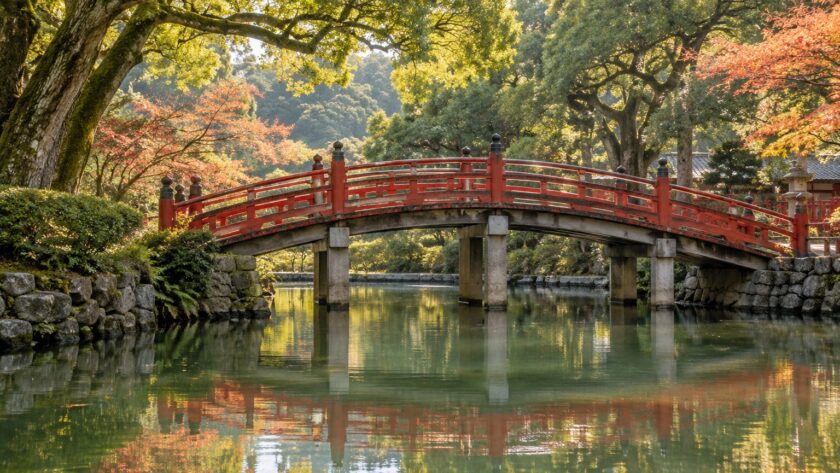
Editorial note: Official information checked October 11, 2026. Prices, opening arrangements, and transport services may change; linked operators provide the latest details. Suggested schedules and planning allowances are editorial recommendations, not guaranteed connections. The featured image is an AI-generated, photorealistic illustration inspired by Dazaifu’s shrine pond and bridges, not a documentary photograph of current conditions.