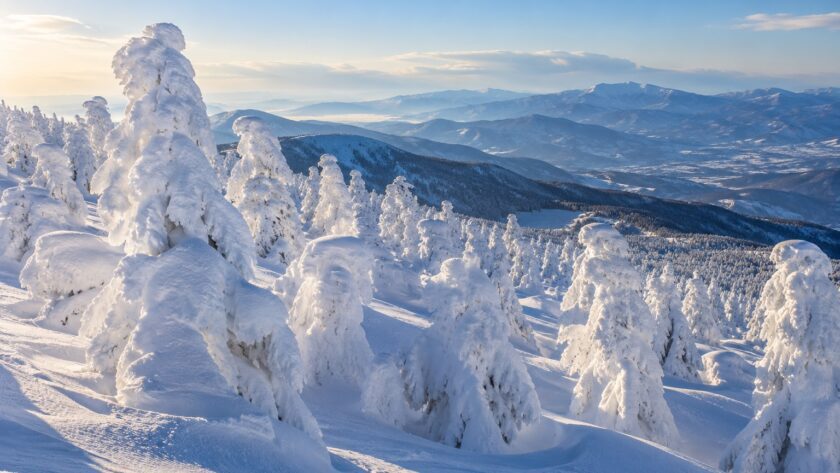
Yamagata rewards travelers who leave room between the headline sights. A morning might begin with stone steps through cedar woods, continue with a bowl of soba, and finish in a hot spring town while the mountains disappear into evening mist. Inland, Yamadera, Zao and Ginzan Onsen offer very different encounters with the landscape. Beyond the mountains, the Shonai plain opens toward the Sea of Japan, with rice fields, coastal cities and the sacred peaks of Dewa Sanzan.
Information checked October 10, 2026. Transport, opening hours, mountain access and winter visitor arrangements can change; consult the official links before traveling. The featured image is an AI-generated, photo-style illustration inspired by Zao’s snow-covered trees, not a photograph of a specific viewpoint.
For a first visit, allow four days for the inland highlights, or six to seven if you also want Shonai. This guide separates those areas so that the trip feels like a holiday rather than a sequence of connections. A shorter stay still works: choose Yamagata City and one mountain destination, and let a satisfying meal or an unhurried bath count as part of the experience.
Understand the map before choosing your base
Yamagata City is a practical starting point for an inland trip. Yamadera lies on the railway toward Sendai, while Zao Onsen sits in the mountains to the southeast. Ginzan Onsen is farther north and requires a separate access plan. These places are often photographed together in travel roundups, but they are not stops on a single convenient sightseeing loop. Use one major excursion per day as your starting assumption.
Tsuruoka and Sakata belong to a different travel area: Shonai, on the western side of the prefecture. If temple landscapes, regional cooking and the coast interest you most, you can make Shonai the main trip instead of an extension. The JNTO Shonai guide introduces both cities and their surroundings. Changing accommodation once is usually a better strategy than repeatedly crossing the prefecture.
When to visit Yamagata
Choose your season around the experience you actually want. Spring suits city walks and cherry blossoms; early summer brings fruit and greener landscapes. Autumn combines changing leaves with hearty seasonal food. Winter is the obvious choice for skiing and snow scenery, but also demands the most flexibility. The official Yamagata overview is a useful introduction to these seasonal differences.
Do not assume the mountains and the city share the same calendar. A comfortable day at station level can coincide with snow, strong winds or closed roads higher up. Likewise, autumn colors progress with elevation, and cherry blossoms vary each year. Pick one seasonal priority, then keep secondary stops adaptable. For a winter trip, an extra night near Zao is more useful than an itinerary that permits exactly one short attempt at the ropeway.
Yamagata City: an easy first afternoon
Begin with Kajo Park, the former grounds of Yamagata Castle. The attraction is the spacious historic landscape, with surviving earthworks, stonework and moat scenery, rather than a towering original castle keep. It is a comfortable introduction after a train journey and especially appealing during cherry blossom season. JNTO’s castle guide places the park around a fifteen-minute walk from Yamagata Station.
Keep arrival day modest. Drop your luggage, walk through the park, and return toward town for dinner instead of immediately chasing a mountain bus. Staying near the station simplifies the following morning, particularly if you are traveling with children or large bags. Use this first afternoon to check excursion connections and buy anything you need for outdoor days. A city night also gives you more choice if your arrival train is delayed.
Yamadera: a mountain temple worth slowing down for
Yamadera is the familiar name for Risshakuji, a Buddhist temple founded in 860. Buildings occupy a steep wooded mountainside above the valley, and the changing relationship between trees, rock and open views is central to the visit. The tourism association’s English map provides a helpful orientation to the temple grounds. Read it before climbing so that the route feels like a sequence of places rather than just a staircase.
This is an active walking visit. The association’s English guiding information describes 1,015 steps on the route to the upper temple area. Leave enough time to pause, look back across the valley and descend carefully. Wear shoes with reliable grip and carry drinking water. In snowy or icy conditions, reassess the climb at the entrance instead of assuming that an ordinary city shoe will be adequate.
Reach the area by the Senzan Line and check which trains stop at Yamadera when planning the journey. Make lunch in the village part of the outing, with a margin before your return service. If stairs are unsuitable for someone in your group, the full upper route is not an accessible alternative; plan a shorter visit around the lower area and confirm specific facilities beforehand. Consult the Yamadera Tourism Association for current local notices.
Zao Onsen: hot springs and a mountain day
Zao Onsen combines a hot spring town with access to mountain scenery and winter sports. It works particularly well as an overnight stay: you can settle into your accommodation, eat without rushing back to the city, and make the next day’s mountain decision with a clearer weather forecast. The local Zao Onsen tourism guide outlines activities across the seasons. Choose accommodation for the kind of stay you want, not just its proximity on a map.
For public transport, consult Yamagata Kotsu’s Zao guide and the linked current bus information. The journey from Yamagata Station is roughly forty minutes under normal conditions, but waiting time and winter road conditions matter too. Confirm the last useful return service before going uphill. If your inn offers a transfer, check its pickup point and reservation requirements directly rather than assuming it meets every bus.
In winter, the famous juhyo are trees transformed by layers of rime and snow. Their size and appearance depend on weather, and visibility is never guaranteed. The JNTO snow-monster guide explains the Yamagata-side approach using the ropeway system. Treat the summit as a cold mountain environment even if you are visiting only for sightseeing; gloves, wind protection and footwear for snow make a substantial difference.
Check the ropeway operator’s snow-monster and operation information close to your visit. Night illumination, ticket arrangements and seasonal programs need their own confirmation, and an old event calendar is not a promise for the coming winter. If wind prevents an ascent, enjoy the town and your bath instead. A flexible booking pattern is more valuable than a tightly scheduled plan built around one perfect photograph.
Outside winter, Okama crater lake may be a separate mountain excursion, subject to road access, transport schedules and volcanic conditions. It is not simply another stop reached by staying on the ordinary Zao Onsen bus. JNTO’s Okama guide specifically distinguishes the bus routes. Confirm your exact destination and return connection before departure, stay on permitted paths, and accept that cloud can hide the lake even when the road is open.
Ginzan Onsen: arrange access before chasing the evening view
Ginzan Onsen is known for its compact riverside setting and traditional inn architecture. An overnight stay allows a different rhythm from a brief sightseeing visit, but rooms can be the hardest part of the itinerary to secure. Start with the accommodation you actually want, then arrange the transport around its check-in and meal times. If you visit for the day, define a realistic arrival and departure window before choosing a restaurant or an evening photography plan.
Winter access deserves particular attention. A Ginzan Onsen official notice dated January 15, 2026 describes visitor controls and private-car restrictions, including park-and-ride arrangements and reservations for some shuttle access. This is evidence that access is managed, not a universal timetable for every future winter. Read the latest notices and your accommodation’s instructions for your actual dates. Do not assume a hired vehicle can take you unrestricted into the center.
Give the town’s everyday needs space. Keep entrances clear, avoid blocking bridges for photographs, and remember that illuminated windows belong to working accommodation. A snowy evening can be beautiful but also slippery and crowded; a daylight visit may be more comfortable for families or anyone with limited mobility. Do not choose a return connection so tight that a short queue becomes a missed train. Staying elsewhere is perfectly reasonable if the available rooms or access arrangements do not suit you.
Dewa Sanzan: plan a separate sacred-mountain visit
Dewa Sanzan comprises Mount Haguro, Mount Gassan and Mount Yudono. For many first-time visitors, Haguro is the most manageable introduction, with a cedar-lined approach and a five-story pagoda. The complete stone stairway has 2,446 steps, so this is another place to match the route to your group’s ability. JNTO’s Dewa Sanzan guide explains the three mountains and their differing access conditions.
Do not equate visiting Haguro with completing all three mountains. Gassan is a substantial mountain outing, while access to higher areas is seasonal. Build a hiking day with suitable equipment, transport margins and current local advice. For a more interpretive experience, consider a guided program or a temple lodging stay, where offered. The national parks guide to spiritual journeys introduces the religious setting and the role of these traditions.
These are places of worship as well as destinations. Follow local instructions about footwear, photography and conduct, especially at Yudono, where restrictions are part of the visit. Avoid treating ceremonies as a performance to interrupt. If you are interested in an overnight spiritual program, ask what participation involves and whether interpretation is available. A thoughtful half day with a guide can be more rewarding than hurriedly collecting three mountain names.
Tsuruoka and Sakata: give Shonai its own time
Use Tsuruoka or Sakata as a base for the western part of the prefecture. Shonai’s appeal is the combination of food, lowland landscapes and cultural visits, with the mountains nearby rather than constantly underfoot. Kamo Aquarium’s jellyfish displays and Sakata’s Somaro offer different possible outings; check each venue’s current hours and booking arrangements before building a day around it. Leave space for a meal rather than trying to fit every attraction into a single coastal day.
Tsuruoka joined UNESCO’s Creative Cities Network for gastronomy in 2014, a recognition discussed in JNTO’s feature on its food culture. Use that as a reason to explore ingredients and preparation, not simply to seek one famous restaurant. Ask what is local and seasonal, and consider a reserved dinner if food is a major reason for traveling. A small menu can tell you more about the region than an overloaded sightseeing schedule.
What to eat: noodles, imoni and seasonal fruit
Imoni, a taro-based stew associated with autumn gatherings, is a good introduction to regional differences. Inland versions commonly use beef and soy sauce, while Shonai versions often use pork and miso. Soba is another satisfying starting point for lunch. VISIT YAMAGATA’s food guide describes these local specialties. Order according to your appetite and the weather: a simple noodle meal can be exactly right between a climb and an afternoon train.
Yamagata is also associated with cherries, and picking experiences can make an enjoyable early-summer outing. Availability depends on the orchard, variety and growing conditions; book a farm with confirmed dates instead of treating a general festival description as a reservation. JNTO’s cherry guide offers background. Travelers with dietary restrictions should explain them in advance, especially for ryokan meals, noodle broth and mixed dishes whose ingredients are not obvious from their names.
A practical four-day inland itinerary
Day one: arrive in Yamagata City, leave your bags at the hotel and walk through Kajo Park. Keep dinner local and confirm tomorrow’s trains. This deliberately light start leaves room for a delayed arrival and avoids turning the first afternoon into an exercise in luggage management. If you arrive late, simply move the park walk to the final morning rather than shortening your rest.
Day two: make Yamadera your main excursion, with time for the climb, lunch and a relaxed descent. Return to Yamagata City for a second night. Strong walkers may have time left over, but there is no need to prefill it. The value of this day is being able to stop where the view or temple setting interests you without watching the clock throughout the visit.
Day three: travel to Zao Onsen and stay overnight. In winter, choose the ropeway window according to conditions and leave room for a second opportunity the following morning. In other seasons, choose an appropriate local walk or a separately planned mountain excursion. Day four: enjoy breakfast and a final bath, return to the city, and continue your journey. This makes a complete trip without Ginzan.
To include Ginzan, add a fifth day or replace the Zao overnight with a Ginzan stay, using confirmed transport and room availability. Trying to combine both onsen towns with Yamadera in two days removes most of the flexibility that makes this itinerary work. For Shonai, add at least two more nights and allow a substantial transfer period. A separate Shonai trip is often the more comfortable choice if your total time is limited.
Make the trip fit your travel style
For families, alternate a demanding walking day with a less structured one. Yamadera followed immediately by the full Haguro stairway may be an attractive pairing on paper, but it is a lot of climbing with a long transfer between them. Choose one as the main physical challenge and let other days focus on food, a park or a comfortable overnight stay. Ask children to choose one experience too; an orchard visit or a snow outing may matter more to them than another landmark.
If photography is your priority, build time around light without making access depend on it. A forecast for sunset does not extend a bus timetable, and the most recognizable image may require conditions that never appear during your stay. Carry batteries where they can stay warm in winter, protect equipment from wet snow, and stop only where you can do so without obstructing others. The quiet details of a meal, a shopfront or a wooded approach can be as memorable as a distant panorama.
Travelers seeking comfort should compare the whole room and meal arrangement when booking an inn. Check whether the room has a private bathroom, whether bedding is on the floor, how many stairs separate reception from the room, and whether private bathing is available. Send specific questions before paying. Two properties described as traditional ryokan can offer very different levels of convenience, and choosing the right one can shape the entire visit.
Getting there, booking well and traveling comfortably
From Tokyo, the Yamagata Shinkansen provides the main rail approach to the inland area. JR East lists Tsubasa as an all-reserved-seat service, so arrange a suitable train in advance. For Shonai, compare an approach through Niigata with air access and onward ground transport. The Bandai-Asahi National Park access guide explains approaches to the Dewa Sanzan area. Choose the gateway that matches your first overnight stop.
A rental car can help with scattered rural stops, but it does not eliminate winter restrictions, parking constraints or mountain closures. On a rail-based trip, carry a smaller overnight bag when possible and verify luggage storage before relying on it. Reserve your most important ryokan first, then match the transport; confirm whether dinner is included and when you must arrive. Keep some cash, save essential route details offline, and have one indoor or lowland alternative ready. Yamagata is most enjoyable when the schedule allows the landscape, weather and local hospitality to set part of the pace.