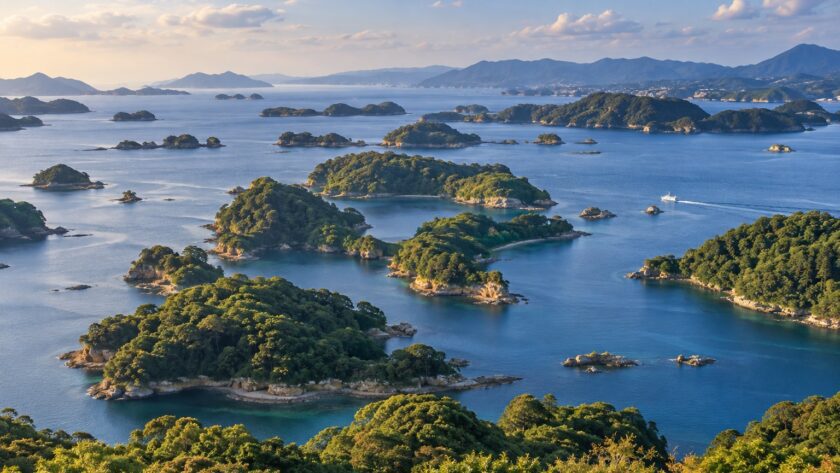
Nagasaki rewards travelers who give its geography as much attention as its famous skyline. A harbor city folds into steep hills; farther north, wooded islands interrupt the sea around Sasebo. Across the Shimabara Peninsula, steam rises from volcanic ground, while offshore communities offer beaches, churches, and journeys shaped by ferry schedules. These places belong to one prefecture, but they do not fit comfortably into a single hurried day.
For a first visit, spend two or three nights in Nagasaki city and choose one regional extension. Five days can combine the city with Sasebo and Hirado, or with Unzen and Shimabara. Add separate nights for the Goto Islands. This guide focuses on making those choices: where history deserves time, when a boat trip needs flexibility, and how to build a route that leaves room for an unplanned lunch or a clear evening above the harbor.
Understand the map before booking
The name Nagasaki refers both to the prefecture and its capital. The city is an excellent base for urban history, waterfront walks, and dining, but it is not the ideal overnight base for every destination. Sasebo serves the northern coastal area; Hirado lies farther northwest. Unzen and Shimabara occupy another peninsula, while the Goto Islands require a sea or air connection. The prefecture’s regional introduction is a useful starting map.
Choose your extension by interest. Sasebo suits travelers who want island scenery without relocating to a remote island. Unzen works well for a hot spring overnight and a change from city streets. Hirado adds a quieter port and another chapter in international trade. Goto deserves travelers willing to slow down and organize local transport. Trying to sample all four usually means sacrificing the evenings that make an overnight stay worthwhile.
Arriving and getting around
From Hakata in Fukuoka, rail journeys to Nagasaki commonly combine a limited express with the Nishi Kyushu Shinkansen, changing at Takeo-Onsen. Do not expect a single shinkansen ride all the way from Hakata. Check the journey offered for your departure through JR Kyushu’s Kamome information, and keep the details for both train segments together when reserving.
Nagasaki Airport is outside the city, so compare the airport connection with your actual first destination. A journey to Sasebo or Unzen needs different planning from one to central Nagasaki. Consult the official airport access overview, then confirm the relevant operator’s current departure. For a late arrival, a hotel near your arrival point may be more useful than a scenic property requiring another bus.
Within the city, combine walking with trams and occasional taxis. Hills can make a short map distance surprisingly demanding, especially with luggage. For regional travel, work backward from the last practical return using the prefecture’s transport guide. A rental car can help on a peninsula or island, but is an extra parking responsibility during urban sightseeing. Check each property’s parking and arrival arrangements before deciding.
Give the peace sites an unhurried morning
The atomic bombing of August 9, 1945 is central to understanding Nagasaki. Visit the Nagasaki Atomic Bomb Museum to engage with the human consequences through objects, photographs, and interpretation. Allow time to read rather than moving through only for recognizable exhibits. Check current opening notices before visiting, particularly around holidays or any exhibition work.
Combine the museum with the nearby hypocenter area and Peace Park, using the city’s peace visitation information to orient yourself. The National Peace Memorial Hall provides another setting for remembrance, with personal accounts and spaces dedicated to the victims. These are distinct places with different roles; a quick photograph of the Peace Statue does not replace the museum or memorial.
Leave the rest of the morning flexible. Some visitors will want to continue reading, while others will need a quiet break. With children, decide in advance how to explain difficult displays and allow them to step away. Follow photography rules, keep voices low in commemorative spaces, and avoid placing an inflexible lunch booking immediately after your museum visit.
Dejima and the city’s trading history
Dejima makes an effective first stop for understanding Nagasaki’s international connections. Originally built as an artificial island, it later housed the Dutch trading post, which moved from Hirado in 1641. Its story involves exchange, regulation, and restrictions on movement, rather than an uncomplicated tale of openness. The site’s historical overview helps place the reconstructed streets and buildings in context.
Allow time for the interiors and interpretation, not just a walk along the main street. Dejima today sits within the modern city: surrounding land reclamation changed its relationship with the water. Read the current visitor information for entrances and admission arrangements. Afterward, walk toward the waterfront or Shinchi Chinatown for a meal; this is a manageable cluster without adding a cross-city transfer between every stop.
Glover Garden and an evening above the harbor
On the slopes of Minamiyamate, Glover Garden brings together historic Western-style residences and harbor views. The collection includes buildings with different original locations, so use the site labels to distinguish their stories. The Former Glover House is the World Heritage component; the designation should not be understood as covering every building in the garden in the same way.
Plan the hillside visit around your walking comfort. Comfortable shoes matter, and travelers with limited mobility should confirm an appropriate entrance and accessible route before arrival. Combine a few nearby stops rather than repeatedly climbing and descending the neighborhood. A café break overlooking the working harbor can be more rewarding than adding another distant attraction simply because it appears nearby on a citywide map.
For the broader view, consider Mount Inasa when visibility is good. The official scenery guide introduces its panorama over the city and water. Arriving before darkness lets you watch the same landscape change, but check transport operations and your return journey that day. Keep this outing movable between evenings: low cloud can matter more than the date printed on an itinerary.
Hashima: book with a weather alternative
Hashima, often called Gunkanjima or Battleship Island, is a former coal-mining settlement off Nagasaki. Its dense concrete remains make an arresting sight, but a visit depends on the sea. Choose an approved operator and read the official landing-tour guidance before booking. The meeting location may differ from the boarding location, and a sailing does not guarantee that landing will be permitted.
If landing is possible, follow the designated visitor route and crew instructions; this is not an invitation to explore abandoned buildings. Read the operator’s cancellation and alternative-cruise conditions. Keep another city activity available if conditions prevent the excursion, and avoid putting it immediately before a departure you cannot miss.
Approach the island as a historical community and industrial site, rather than only as a dramatic ruin. UNESCO’s conservation decision stresses interpretation of the property’s full history, including periods beyond the industrial era recognized in the inscription. Seek accounts of the people who lived and worked there alongside explanations of its engineering and architecture.
Sasebo and the island scenery of Kujukushima
Kujukushima offers a very different encounter with the sea: wooded islands, sheltered channels, and changing layers of shoreline. A sightseeing cruise from the Pearl Sea area is an approachable way to see the landscape from water level. Use the cruise operator’s current website to check available vessels and departures instead of relying on an old photograph of a particular boat.
Choose your experience before arriving. A larger sightseeing vessel and a smaller boat are not interchangeable in comfort or accessibility; check the operator’s vessel information if steps, seating, or toilets affect your plans. Routes can change with conditions. A shore viewpoint complements a cruise, but leave enough time to reach it and return without turning the afternoon into a series of taxi deadlines.
Stay in Sasebo if you want a relaxed dinner after the coast or plan to continue to Hirado. If visiting from Nagasaki city, treat the coast as the day’s main activity and check the return train in advance. Take wind protection even in pleasant weather: comfort on an exposed deck can differ from comfort outside the station.
Hirado for a smaller port and a longer story
Hirado offers a castle, a harbor, and a reconstructed Dutch Trading Post that helps connect its history with Dejima. The prefecture’s area sightseeing guide introduces these landmarks. It is especially rewarding after reading about early trade, because you can understand the two ports as parts of a changing relationship with the outside world.
Give Hirado a day rather than squeezing it between two large destinations. Choose a harbor walk and one substantial historical visit, then leave space for lunch. If arriving by public transport, remember that Tabira-Hiradoguchi station is not in Hirado’s island town center; an onward connection is required. Check that final connection in both directions. An overnight stay can simplify the day, provided your accommodation can explain evening dining and local transport options.
Unzen and Shimabara: steam, baths, and peninsula travel
Unzen changes the atmosphere completely. In the mountains of the Shimabara Peninsula, volcanic steam and hot spring accommodation replace the harbor city’s bustle. The Ministry of the Environment’s Unzen-Amakusa National Park introduction explains the relationship between this volcanic landscape and the surrounding seas. Unzen Jigoku offers a close view of geothermal activity from established walking routes.
Stay on marked paths and respect barriers around hot ground and vents. A town walk is different from a mountain hike: do not assume that a route pictured in a brochure is currently open. Check local advice, weather, and notices through the national park website before planning higher trails. Leave mountain excursions optional when visibility or conditions are poor.
An overnight hot spring stay works best with an early arrival. Confirm whether dinner is included and when you must check in; a delayed bus can otherwise affect the meal you booked. Shimabara adds a castle town visit on the peninsula, but check the regional access information before combining it with Unzen. With public transport, select a few stops that fit the timetable rather than attempting a complete peninsula circuit.
Goto: add nights, not a rushed detour
The Goto Islands are a separate chapter of a Nagasaki journey. For an introduction centered on Fukue Island, the prefecture’s Goto travel guide outlines air and sea access. Decide which island and arrival port you need before booking accommodation. A map label covering the archipelago does not mean that every beach or church is accessible from one base without another crossing.
Allow at least two or three nights if your schedule permits, with local transport arranged for the places you most want to see. Do not make your return ferry the only connection protecting a major international departure. Weather can change sea travel, so build a mainland buffer and understand the booking conditions. A slower island day with one beach and one cultural stop is preferable to a route that depends on every connection working perfectly.
Church visits require particular care. The Goto tourism authority’s church guidance explains advance contact requirements for some sites and appropriate behavior. These remain places of faith; worship takes priority over sightseeing. Confirm access, follow photography restrictions, and do not enter an altar area. Read the history of the individual community rather than assuming all churches and Hidden Christian sites tell an identical story.
What to eat along the route
In Nagasaki city, begin with champon or sara udon. Champon combines noodles with broth and assorted ingredients; sara udon offers a different texture, commonly with a thick topping over crisp noodles, though styles vary. The prefecture’s noodle-dish introduction explains their local background. Trying them on separate days makes a useful comparison without ordering more than you can enjoy.
Castella is another familiar Nagasaki specialty, shaped by a confection introduced from Portugal and developed locally. The official food guide offers context for this and other regional dishes. Buy a size that suits your onward journey and check storage instructions. For dietary restrictions, ask about the actual preparation: a vegetable-rich noodle dish may still contain pork, seafood, or animal stock.
A flexible five-day first itinerary
Day one: arrive in Nagasaki, settle in, and visit Dejima if your arrival leaves enough time. Keep dinner nearby. Day two: reserve the morning for the museum and peace sites, then choose a gentle afternoon. Day three: explore Minamiyamate and Glover Garden, with Mount Inasa on whichever evening has the best visibility. A Hashima excursion can replace another half-day, subject to its actual schedule and sea conditions.
For days four and five, choose one branch. The northern option moves to Sasebo for Kujukushima, followed by Hirado if connections fit. The peninsula option heads toward Unzen for a hot spring night and continues to Shimabara. Do not combine both branches into the same two days. If Goto is your priority, replace the regional branch and extend the trip to protect your island time and return buffer.
Choosing dates and a realistic budget
Choose your travel dates around the experience you would most regret missing. If that is island scenery, allow spare time for a weather change. If it is a particular museum, check its calendar before buying transport. A holiday itinerary should start with accommodation availability and confirmed departures, rather than an assumption that everything will follow an ordinary weekday pattern. Travelers who prefer quieter sightseeing can also avoid concentrating all their visits into the middle of the day: a comfortable breakfast and an early start may leave more room for pauses later.
Build a budget around the complete route. Add local connections, admission, a cruise, and any luggage or parking costs to the headline train fare. Compare a rail pass against the journeys it actually covers; island boats and regional buses need their own checks. For a hot spring inn, compare room-only and meal-inclusive options with the cost and availability of eating elsewhere that evening. Keep a small reserve for a taxi or an extra mainland night if a connection changes. Traveling with someone who cannot manage many steps may make a conveniently located room or a direct transfer worth more than another paid attraction. Agree on that priority before filling the schedule, so that the whole group can enjoy the places you choose. Keep booking references and the accommodation address available offline, especially when your day includes several transfers.
Practical choices that improve the trip
Match accommodation to the next morning’s departure. A harbor-side address may help before a ferry, while a station-area hotel may suit rail travel; check the actual walking route rather than the neighborhood name. Pack light enough to manage slopes and transfers. Keep a small overnight bag ready if you plan to leave larger luggage with a hotel that has confirmed storage.
Keep the most weather-sensitive experiences flexible and reserve the commitments that have limited capacity, such as a chosen cruise or an inn dinner. Before travel, recheck the linked official sources for opening notices, transport, and visit arrangements. Nagasaki is most satisfying when its difficult history, everyday food, and coastal landscapes each have enough time to register, rather than competing for the last available hour.
Editorial note: Official sources checked on October 11, 2026. Transport, opening arrangements, and access can change; reconfirm before travel. The featured image is an AI-generated illustration inspired by Kujukushima in Nagasaki, not a documentary photograph of a specific viewpoint.