Kumamoto is a place to travel between contrasting landscapes. In the city, a reconstructed castle tower rises above immense stone walls and streets busy with everyday life. Eastward, Aso opens into grasslands and a vast inhabited volcanic landscape. Farther into the mountains, an overnight stay at Kurokawa Onsen can slow the journey to the pace of a bath and dinner. To the west, Amakusa brings fishing villages, church history, and open water.
The challenge is choosing which of these experiences belongs in the same trip. A city break with an Aso excursion is very different from a coastal journey through Amakusa. For a first visit, allow four or five days for Kumamoto city, Aso, and one hot spring overnight. Give Amakusa separate nights or make it your main regional extension. This guide explains the choices, with practical ways to avoid spending your holiday chasing distant map pins.
Choose a region, then choose your overnight bases
Kumamoto city is the main urban base, with a shinkansen station, hotels, restaurants, and tram connections. Aso lies inland to the east, and Kurokawa Onsen is farther north in the mountain region. Amakusa extends west toward the sea. The Japan National Tourism Organization’s prefecture overview provides a useful introduction to this mix of castle history, volcanic scenery, and hot springs.
Start with one clear priority. Choose the city and Aso for a first encounter with Kumamoto’s best-known landscapes. Choose Amakusa if coastal villages and maritime outings matter more than mountain viewpoints. Choose a longer hot spring stay if rest is the purpose of the trip. These options can eventually be combined, but they deserve more time than a route that changes accommodation every night and treats each transfer as sightseeing.
Arriving by train or air
The Kyushu Shinkansen connects Kumamoto with Fukuoka to the north and Kagoshima to the south. Kumamoto Station is a transport hub rather than the doorstep of every city attraction. Before reserving a hotel, compare its access to the castle area, evening dining, and the departure you need the following morning. The city’s official sightseeing map helps place the station, tram network, and central attractions.
Aso Kumamoto Airport is outside the city center. Consult the airport’s official access page for bus connections, rail-link options, and rental car information. Check the effective date of a timetable or fare notice: a page may display an upcoming change as well as current arrangements. Do not use a quoted driving time as a guarantee when planning a flight connection.
For Aso by rail, look up your exact travel date and onward transport. JR Kyushu’s ASO BOY! page shows the sightseeing train’s route and operating calendar, but it is only one possible service. Reserve the journey you actually want, then check how to reach your accommodation or viewpoint after leaving the train. Arriving at Aso Station does not put you at the crater.
Kumamoto Castle: read the rebuilding story
Kumamoto Castle is worth more than a photograph of its black-and-white tower. Its history includes construction under Kato Kiyomasa, rule by the Hosokawa family, destruction by fire, modern reconstruction, and earthquake damage. The castle’s historical introduction explains these layers. Recognizing them makes the visit more interesting than expecting an entirely unchanged building from the seventeenth century.
The restored main tower reopened its interior in 2021, with exhibitions tracing the castle’s history and the effects of the 2016 earthquake. Its reopening does not mean that every part of the wider complex has completed restoration. Read the official exhibition overview, and allow time for the displays before going to the upper viewing area.
Check the current visitor information for entrances, admission, and accessible arrangements. Follow the designated route and respect works areas. Travelers using a wheelchair or avoiding long walks should confirm the practical route rather than judging accessibility from a photograph of the tower. Leave a generous part of the morning for the castle, including the approach, and choose lunch nearby afterward.
Suizenji Jojuen and a gentler city afternoon
After the castle, Suizenji Jojuen offers a different scale: a spring-fed pond, shaped hills, paths, and carefully arranged views. The garden’s official website describes its beginnings under Hosokawa Tadatoshi in the early seventeenth century. Walk slowly around the pond instead of treating the garden as a single viewpoint. Small changes in position reveal different relationships between water, trees, and the mound that recalls Mount Fuji.
Visit Izumi Shrine respectfully if you include it in the walk, and check the garden’s announcements before expecting a performance or special event. For a simple afternoon, pair the garden with tea and an early dinner rather than another long excursion. This is also a useful way to recover from a travel day without abandoning sightseeing entirely.
Keep an unscheduled hour for central Kumamoto. Browse a shop, compare menus, or sit down with a local snack. A city overnight is useful precisely because it removes the pressure to catch the final train immediately after the castle. If rain changes your plans, use the official city sightseeing directory to choose an indoor stop suited to your interests and current opening times.
Aso: understand the landscape beyond the crater
Aso is not just one summit or one ticketed attraction. Its broad caldera contains settlements, fields, and roads, with volcanic peaks rising within the larger landscape. A satisfying visit gives time to understand that scale. The regional tourism association’s Aso cultural guide introduces the relationship between the volcano and communities living around it.
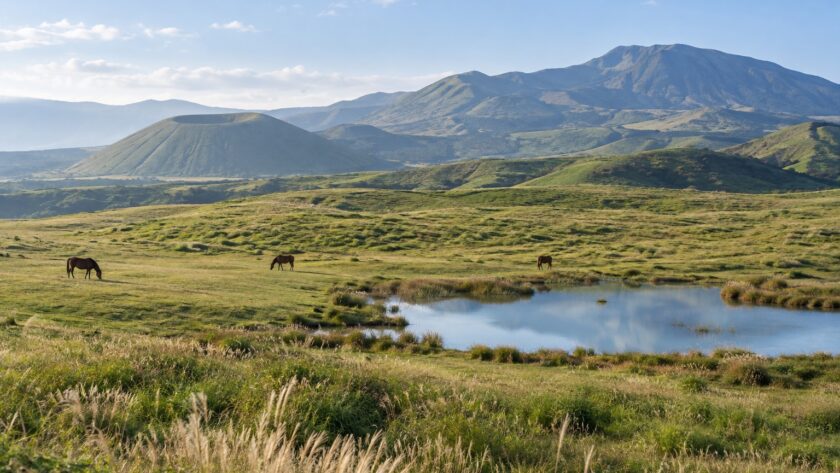
Kusasenri is an accessible introduction to the upland scenery, with open grassland, ponds, and grazing horses described in Aso City’s sightseeing guide. Water levels, grass colors, and visibility vary, so do not expect every visit to match a summer publicity photograph. Use the permitted walking areas, give animals space, and avoid stepping into restricted pasture for a clearer picture.
Daikanbo provides a different perspective from the northern rim, looking across the valley toward Aso’s central peaks. The Kyushu Tourism Organization’s viewpoint page explains the panorama. In clear conditions, this is a place to pause and read the shape of the land. In low cloud, accept that the view may disappear; there is little benefit in driving between several overlooks that share the same weather.
Nakadake crater: make access conditional
A visit to the active crater must remain optional. Access can change because of volcanic activity, gas, wind, or weather, including after you begin your journey. Consult the official crater restriction map and local announcements on the day. An open road to part of the mountain does not establish that the crater viewing area is open.
The authority’s visitor precautions also prohibit crater access for people with asthma, bronchitis, or heart problems because of volcanic gases. Read the full guidance, follow monitors’ instructions immediately, and do not cross barriers. A general travel itinerary cannot determine whether this particular visit is appropriate for everyone in your group.
Build the day so it still works without the crater. Spend longer at a permitted grassland stop, choose a town lunch, or return to your accommodation earlier. In winter, confirm road conditions separately from volcanic restrictions; the local Aso winter access guidance explains why snow and ice can create another layer of closures. Do not interpret winter tires as permission to enter a closed road.
Minamiaso: take the railway at its own pace
On the southern side of the Aso region, Minamiaso Railway offers a way to experience the countryside without spending the entire day behind a steering wheel. The line connects the Tateno area with Takamori. The tourism council’s English railway guide introduces the route and the open-air Yusuge sightseeing train. Ordinary transport and the sightseeing train have different purposes and arrangements.
Check the railway operator’s current timetable and notices before planning around a specific train. Do not assume that a sightseeing service operates every day or that an attractive stop has frequent onward connections. Choose one walk or local meal that fits the schedule, and confirm the return before getting off. For families, the ride itself can be the day’s main activity rather than a short connector between too many attractions.
Kurokawa Onsen: make the overnight count
Kurokawa Onsen is a good reason to leave a large part of an afternoon empty. Inns, outdoor baths, and village lanes create a compact hot spring destination, but the best visit is not necessarily the one with the most baths. The official regional introduction explains the town’s atmosphere and its bath-hopping tradition. Ask locally about the current Nyuto Tegata pass and participating baths rather than relying on older printed prices.
When choosing an inn, read the room and meal plan carefully. Confirm whether dinner and breakfast are included, the required arrival time, and whether dietary requests can be accommodated. If private bathing, tattoo policies, steps, or sleeping arrangements affect your comfort, ask the property directly before reserving. These details are more important than choosing solely from an appealing photograph of an outdoor pool.
Use the ryokan association’s access guide to plan the final approach, then reconfirm current services with the operator. If an inn offers pickup, arrange it explicitly. Arrive early enough to settle in, walk, and bathe before dinner. Avoid a morning schedule that requires rushing away immediately after breakfast: some of the value of an overnight is simply having time to enjoy where you are staying.
Amakusa: a separate coastal chapter
Amakusa deserves its own plan because coastal roads, islands, and scattered attractions create substantial travel between stops. Choose your base around the experiences you want, rather than assuming any accommodation with an Amakusa address is equally convenient. Two nights can give a more comfortable introduction than a single long day from Kumamoto city, particularly if you want both cultural visits and time on the water.
Sakitsu is a fishing village associated with the history of Hidden Christians. The official Sakitsu introduction explains its World Heritage context and its distinctive church. The significance lies in the village and community’s history, not simply in photographing a European-looking building. Start with local interpretation and look at how the church sits among houses and the harbor.
Contact the guidance center about church admission before arrival. JNTO’s visitor guidance notes advance arrangements and the prohibition on photography inside; confirm current opening details directly rather than treating an older article’s timetable as permanent. Residents and worshippers take priority. Keep voices down, use designated parking, and never enter private lanes or homes because they frame a picturesque view.
Dolphin watching with realistic expectations
A boat outing can add a memorable wildlife experience to Amakusa. The Amakusa Dolphin Watching Information Center organizes trips to see wild dolphins and publishes booking and operational information. These are free-ranging animals, so a high advertised encounter rate is not a promise for your sailing. Weather and sea conditions can also affect departure.
Confirm the precise meeting port, check-in requirements, total charges, and cancellation policy with your chosen operator. Do not assume every Amakusa dolphin tour departs from the same place. Follow crew guidance, wear the supplied safety equipment as directed, and observe without feeding or attempting to touch animals. Leave some flexible time after the cruise rather than making a tight onward connection depend on an exact return.
Yamaga for theater and a smaller town visit
If you prefer architecture and cultural history to another mountain day, consider Yamaga in northern Kumamoto. Its Yachiyoza Theater was built in 1910 by local merchants and remains a venue for performances. The Kikuchi River Basin heritage guide places it within the region’s trading and cultural history.
Check the theater’s current announcements before assuming you can tour its interior. A performance day may offer a very different experience from an ordinary sightseeing visit, with separate ticketing. Make Yamaga a deliberate excursion, allowing time for a town walk and lunch, instead of attaching it to an already full Aso day merely because both lie outside the city.
Eat beyond one famous dish
Kumamoto’s food gives another reason to stay overnight in the city. Karashi renkon combines lotus root with mustard and miso, finished with a fried coating; its assertive flavor makes a small serving a sensible introduction. The city’s food guide explains this local specialty. Ask about ingredients and preparation when dietary requirements matter, rather than assuming a vegetable-based dish meets every restriction.
For something sweet, try ikinari dango: a dumpling combining sweet potato, bean paste, and a soft outer dough. The Ministry of Agriculture’s traditional-food profile describes its local roots. It makes a satisfying break between sights. In the Aso area, akaushi beef is another regional choice; the Kumamoto tourism food feature introduces the connection with locally raised red-haired cattle. Choose dishes you actually enjoy rather than turning meals into a checklist.
A five-day first visit that leaves room to breathe
Day one: arrive in Kumamoto, check in, and use the remaining time for an easy city walk and dinner. Day two: devote the morning to the castle, then choose Suizenji Jojuen for the afternoon. Keep the evening free enough to try a different restaurant or local snack without another journey hanging over the meal.
Day three: travel to Aso and concentrate on one cluster of scenery. Kusasenri and an optional crater visit can belong together if conditions and transport allow; do not force in every lookout. Day four: choose another Aso perspective or a Minamiaso railway outing, then continue to your planned hot spring accommodation if the connections work. Day five: enjoy breakfast and return with a comfortable margin for the next stage of your trip.
For an Amakusa-focused version, replace the mountain and hot spring section with two coastal nights. Plan Sakitsu and your boat trip on separate portions of the stay, checking actual distances and operating times. If Yamaga interests you more than the coast or volcano, substitute it for a regional day. These are alternatives to adapt, not obligations to stack into the same five days.
Before you set out
For a trip without a car, write down the return connection as carefully as the outbound one. Leave room to find the correct stop, collect stored bags, and buy food before a rural departure. Save the destination in Japanese as well as English so that station staff or a driver can help if needed. In a group, agree which activity can be dropped when delays occur. Choosing that calmly before departure is easier than negotiating it at a bus stop while everyone is tired.
Book the limited-capacity experiences first: a particular inn, a preferred sightseeing train, or a boat trip. Keep weather-dependent viewpoints flexible around them. Compare the total cost of local transfers, accommodation meals, parking, and admissions before choosing between a car and public transport. A low headline rail fare does not settle the transport question if the last part of the journey requires a taxi.
Carry layers for the uplands, walking shoes, rain protection, and an offline copy of your accommodation details. Recheck official notices before each regional transfer. Above all, build a trip that remains enjoyable when a crater closes or clouds cover a panorama. Kumamoto offers enough history, food, village life, and bathing to reward a visit without every plan unfolding exactly as imagined.
Editorial note: Official sources checked on October 11, 2026. Opening arrangements, transport, volcanic restrictions, and weather conditions can change; reconfirm before visiting. The featured image is an AI-generated illustration inspired by the Aso grasslands in Kumamoto, not a documentary photograph of a specific viewpoint.