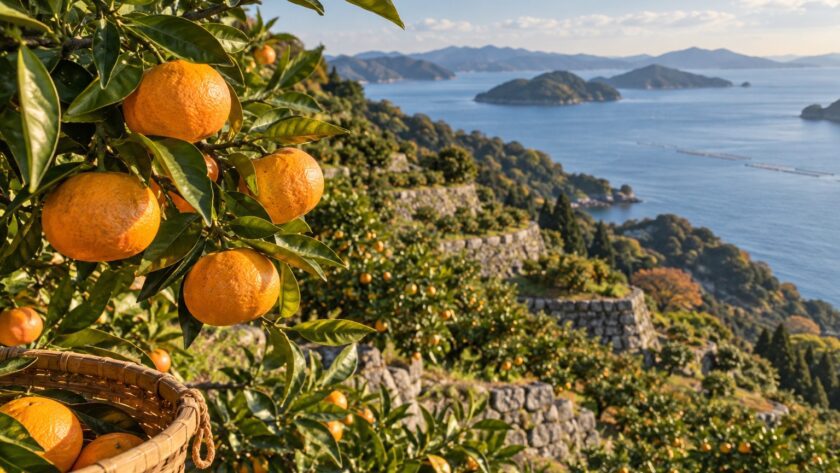
Ehime brings together several very different pleasures: a bath in a historic wooden building, a hilltop castle above a tram-filled city, a bicycle ride between islands, and a quiet walk through a town shaped by the wax trade. Citrus orchards color the coastal hills, while the mountains offer a more demanding kind of adventure. The prefecture works particularly well for travelers who want culture and scenery with enough space between the main experiences.
Begin with Matsuyama, then choose whether to travel northeast toward Imabari and the Shimanami Kaido or south toward Uchiko, Ozu, and Uwajima. Five days allow a useful introduction, but a week is better if you want both island cycling and southern towns. The distances are manageable when considered individually; the difficulty comes from combining too many directions in a single day. This guide helps you build an itinerary with realistic connections and time to enjoy the stops.
Getting to Ehime and Understanding the Map
The prefecture’s official access guide describes flights to Matsuyama, rail connections through Okayama, highway buses, and ferries from western Japan. Choose your arrival point according to the part of Ehime you plan to explore. A ferry into the south may be convenient for Uwajima or Ozu, while Matsuyama Airport is a straightforward gateway for the capital and Dogo. Check the onward journey before buying the main ticket.
In Matsuyama, JR Matsuyama Station and Matsuyama City Station, also called Matsuyama-shi, are separate places. The latter belongs to the Iyotetsu network. The getting-around guide explains this distinction and the region’s transport operators. Confirm the actual departure station on every booking. A hotel described as near a station may still require a transfer to the railway you need the next morning.
Public transport supports a city-and-town itinerary, especially if you limit each day to a clear destination. Rural coastlines and mountain areas require more attention to the final connection. Renting a car can broaden your options, but driving time, parking, and narrow roads still count. For a trip without a car, compare bus frequency and accommodation pickups before deciding that an attractive rural hotel is a convenient base.
Matsuyama Castle: See the City from Above
Matsuyama Castle stands above the city on a wooded hill. Its stone walls, gates, and surviving keep reward a slower approach than a quick ascent for the view. Look at how the route turns and narrows as you move toward the inner buildings. These changes help explain the defensive layout, while the panorama places the modern streets, surrounding plain, and distant sea in context.
A ropeway and a separate chairlift assist the uphill journey, but there is still walking between the upper station and the keep. The castle’s operating notice explains that final approach and notes that the chairlift does not run in rain. Check current service information before setting out, particularly in poor weather. Choose the enclosed ropeway if the exposed chairlift does not suit your comfort or circumstances.
Allow time for stairs inside the historic buildings and for the descent. Keep admission hours separate from transport operating hours: a ride uphill late in the day does not guarantee enough time to enter the tower. If mobility is limited, ask staff about the parts of the grounds that are realistic for your group. Comfortable footwear and a light bag make the visit easier, even when you use transport for most of the climb.
Dogo Onsen: Choose the Bathing Experience First
The best-known bathhouse in Dogo is Dogo Onsen Honkan, but the area also includes Asuka-no-Yu and Tsubaki-no-Yu. They offer different settings and bathing arrangements. Honkan is especially appealing for its historic architecture and layered wooden exterior. Asuka-no-Yu presents another approach to the bathhouse experience, while Tsubaki-no-Yu provides an alternative worth considering when choosing a facility rather than simply joining the first queue you see.
Read the official facility guide before purchasing a ticket. Different courses combine bathing with different resting spaces, and availability can affect the visit. Decide whether you want a simple bath, time to relax afterward, or a particular room. Do not assume that a general bathing ticket includes every room visible in photographs, or that a room described as private necessarily contains a private bath.
The official FAQ identifies which special rooms and tours can be reserved. It also makes clear that the public bathhouses do not provide overnight accommodation. Book a separate hotel or ryokan if you want to stay in Dogo. If you have a reservation, follow the indicated check-in procedure; if you do not, leave flexibility for waiting rather than placing the bath immediately before a fixed train departure.
Wash before entering the shared bath, keep towels out of the bathing water, and follow the facility’s guidance about belongings and changing areas. Ask staff about any specific access or bathing concern before buying your ticket. Avoid photographs in bathing and changing areas. Afterward, allow a little time for the nearby streets instead of rushing away: an evening stroll and a citrus drink can make the visit feel like part of a neighborhood.
Choosing Where to Stay in Matsuyama
Before an early departure, check whether your hotel can arrange a taxi or explain the first useful tram. Keep station names and your accommodation address saved in Japanese as well as English for an easier conversation with staff. A central Matsuyama hotel is useful for restaurants, shopping, and onward transport, while a Dogo stay places the bathhouses and evening atmosphere close by. Compare the first and last journeys of your day. Saving a few minutes on arrival is less useful if every dinner or early departure involves an inconvenient connection. If your accommodation includes dinner, confirm the latest check-in and dining time before adding another excursion.
For a two-night city stay, put the castle and central streets on one day and Dogo on another, leaving space for a craft visit or a slower morning. This arrangement gives you room to adjust to weather. It also avoids turning the bath into a short appointment between sightseeing obligations. Travelers arriving after a long journey may enjoy beginning with dinner and a walk, then seeing the castle when rested.
Imabari and the Shimanami Kaido
The Shimanami Kaido connects Imabari in Ehime with Onomichi in Hiroshima through islands and bridges. It is a cycling destination, but you do not need to complete the entire route to enjoy it. A shorter outing from the Imabari side can provide bridge views and a sense of the island landscape. Decide the distance according to your riding experience and available daylight, not according to the most ambitious itinerary you find online.
Start with the operator’s bike rental information. Bicycle categories have different pickup locations, return conditions, and rental periods. In the current scheme, sports e-bikes require same-day return, while some other categories allow multiple days. Confirm the exact bicycle and return terminal on your reservation. Rules at one provider do not automatically apply to another company’s bikes or to a different rental category.
The Japanese rental conditions provide a further reference when checking availability or recent changes. Ask about helmet fitting, handling problems, and what to do if you cannot complete the intended route. Battery assistance helps with effort but does not eliminate wind, time in the saddle, or the need to handle a bicycle confidently. Choose a manageable ride before deciding whether extra assistance is useful.
Build the day around a confirmed return plan. A one-way bicycle drop-off does not arrange onward transport for you, and a bus may not carry an assembled bicycle. Save the relevant terminal and transport information offline, carry water, and stop off the riding line for photographs. Bridge approaches add climbing and distance; they should be included when estimating how long a seemingly short crossing will take.
Omishima: Add Culture to an Island Stay
On Omishima, Oyamazumi Shrine offers a different focus from the bridges. Its grounds include large camphor trees, and its treasure collection reflects connections with warriors and seafaring. Treat the worship area and museum as separate parts of the visit, checking their respective access arrangements. You can appreciate the atmosphere of the precincts without reducing the shrine to a brief photograph beside a tree.
An island overnight gives you more freedom to explore without watching the return clock throughout the afternoon. Choose accommodation near your intended route and confirm dinner availability, bicycle storage, and check-in arrangements. A property on the same island can still be far from the main cycling corridor. If you add a shrine, viewpoint, or waterfront detour, recalculate the day rather than assuming it fits inside the original distance.
Uchiko: Wax Merchants, Streets, and a Closure to Know
Uchiko’s Yokaichi and Gokoku historic district reflects prosperity built partly on vegetable wax. Pale earthen walls, plaster details, and merchant houses give the streets a distinctive appearance. Many buildings remain homes or working businesses. Walk slowly enough to notice the craftsmanship, but leave entrances clear and avoid treating every side passage as public space. The town rewards attention to small details rather than a search for a single landmark.
The Japanese Wax Museum and Kamihaga Residence connect the architecture with the industry that paid for it. Production spaces, tools, and domestic rooms show how a commercial household operated. This is a useful first stop because the streets become easier to understand afterward. Ask about guided interpretation if available, and check current opening information instead of assuming every historic residence can be entered.
There is an important planning update: Uchiko-za Theatre is closed for major conservation and seismic work that began in September 2024 and was expected to take roughly four years. Do not plan a normal interior tour of the main theater during this period. The tourism office describes a separate backstage dressing-room display available during the works; verify its current arrangements before visiting.
Allow a substantial half day for Uchiko if you enjoy architecture and interpretation. The walk from the station is part of the excursion, so store heavy luggage where available before beginning. Combining Uchiko with Ozu is possible with suitable connections, but two rushed town visits are less rewarding than one with time for a museum and lunch. Overnight accommodation offers another way to enjoy the streets after day visitors depart.
Ozu: A Castle Town Rebuilt with Care
Ozu lies along the Hijikawa River, with a castle, merchant streets, and historic buildings adapted for present-day use. Its conservation story is part of the attraction. The castle keep was reconstructed in wood, with the project completed in 2004. Appreciate the skill and research involved without confusing it with an original surviving keep. The surrounding town shows how preservation can include active shops, accommodation, and everyday life.
Garyu Sanso, a villa overlooking the river, offers a more intimate architectural experience. Its buildings and garden were arranged to respond to the landscape, and the riverside pavilion rewards careful observation. Notice changes in materials, roof forms, and the view through openings. Leave room for other visitors in narrow interiors, and follow instructions about shoes and photography rather than assuming all rooms operate alike.
Choose two major interiors and leave the remaining time for the town. A meal or café stop in an adapted historic building helps connect preservation with the present. If you stay in a dispersed hotel whose rooms occupy different properties, check where reception and breakfast are located. The address of your room may not be the place where you should arrive with your luggage.
Uwajima and the Southern Extension
Farther south, Uwajima Castle preserves a historic wooden keep above the city. The approach includes steep stone steps, so allow enough energy and daylight for the climb and descent. Its scale offers a different experience from Matsuyama’s larger castle complex. Look at the wooden interior and the relationship between the hill, city, and bay rather than expecting every castle visit to feel the same.
Uwajima makes sense as a separate overnight or a carefully planned extension from the southern towns. Do not add it casually after a full day in both Uchiko and Ozu. Check the last useful train and the distance from your accommodation to dinner. Travelers continuing toward Kyushu should compare the appropriate ferry port and onward connection; being in southern Ehime does not mean you are already at the departure terminal.
Food and Craft: Citrus, Taimeshi, and Tobe Ware
Ehime’s regional food guide introduces its citrus and two contrasting taimeshi traditions. In the Matsuyama or Hojo style, sea bream is cooked with rice; the Uwajima version uses sliced raw fish with a seasoned mixture served over rice. Ask which preparation is offered before ordering, especially if you prefer cooked fish. The shared name does not mean the dishes are interchangeable.
Sample citrus according to the season, comparing sweetness, acidity, and aroma rather than looking only for one familiar variety. Juice and preserves can offer another way to taste the range. Orchard landscapes are working farmland: enter only where a farm welcomes visitors, and reserve harvesting activities if offered. A basket of fruit by a path is not an invitation to pick or take it.
For a practical souvenir, explore Tobe pottery, known for everyday tableware and distinctive painted designs. At the pottery center, visitors can browse work and investigate making or painting experiences. Confirm whether a workshop requires firing afterward, how long completion takes, and whether delivery to your destination is available. Buying a finished cup is simpler when your departure is too soon for a newly made piece.
Mountains, Seasons, and Choosing Your Pace
Mount Ishizuchi is a serious mountain destination, not an automatic side trip after a city morning. The ropeway provides access toward a trailhead rather than delivering visitors to the highest summit. Choose any mountain outing according to current conditions, equipment, experience, and daylight. Research the specific route separately and use a guide if that is appropriate for your group.
Spring and autumn can suit walking and cycling, but coastal comfort does not predict mountain weather. Summer calls for shade and regular breaks, while winter can sharply change higher routes and transport. Keep an indoor or lower-level alternative when an exposed ride or mountain excursion is central to your plans. Avoid booking several nonrefundable activities that all depend on the same favorable weather window.
A Five-Day Route with Room to Adapt
Spend the first two days in Matsuyama: visit the castle and central streets, then give Dogo its own unhurried afternoon or evening. Use day three for either a short Shimanami ride from Imabari or a craft-focused excursion. If cycling is your main interest, sleep near the route and extend it over another day using a rental category that permits your plan.
For days four and five, choose Uchiko and Ozu, with an overnight that reduces backtracking. Add Uwajima only by extending the trip or dropping another destination. A week allows a more balanced combination of city, islands, and the south. Reserve the specific experiences that matter, check current closures, and let meals and ordinary streets fill the gaps. Ehime is especially rewarding when the journey leaves enough time to notice how its coast, commerce, and craft traditions connect.
Editorial note: Official sources were checked on October 11, 2026. Bathhouse courses, bicycle rental rules, transport, restoration closures and mountain conditions can change; consult the linked operators before travel. The featured image is an AI-generated illustration inspired by Ehime’s citrus-growing coast, not a documentary photograph of a specific orchard.