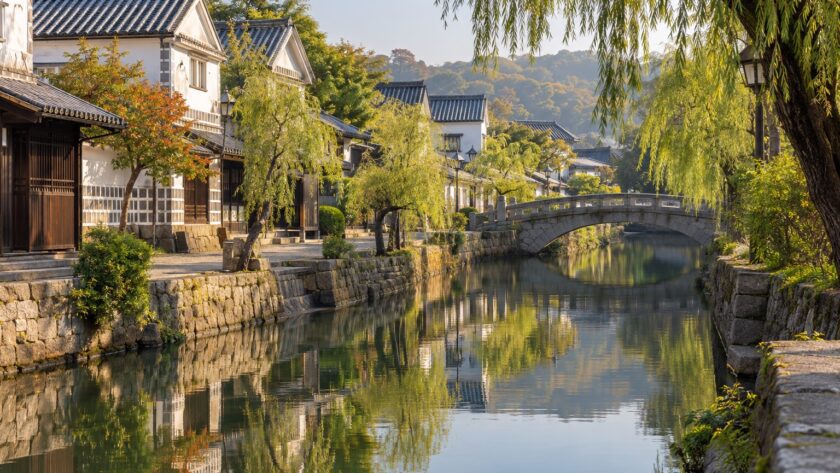
Okayama is an inviting place to slow down between Japan’s larger cities. A spacious landscape garden opens toward a dark castle, willow branches hang over Kurashiki’s canal, and pottery shops invite you to notice the marks that fire leaves on clay. Farther afield, denim makers, mountain castles, and views across the Seto Inland Sea give the prefecture a character that extends well beyond its transport connections.
The challenge is choosing a route that leaves enough time to enjoy these differences. Okayama city and central Kurashiki make an easy introduction; Bizen, Kojima, and Takahashi each deserve a deliberate excursion. Two days cover the main urban sights comfortably. Four days allow a more personal journey, while northern destinations such as Tsuyama and Hiruzen work best with additional time or a separate focus.
Arriving in Okayama and Choosing a Base
Okayama Station is a major rail gateway on the Sanyo Shinkansen, useful for journeys from the Kansai region, Hiroshima, and farther west. The prefecture’s official access guide outlines rail, air, and road approaches. Compare connections for your own travel date, including the journey from the station to your accommodation. A convenient intercity arrival does not mean every rural attraction has frequent onward transport.
Stay near Okayama Station if you want to make several rail excursions without moving hotels. Central Kurashiki is appealing if evening walks and the canal district are your priority. Check the location carefully: Kurashiki Station serves the city center, while Shin-Kurashiki is a different station. Kojima is also within Kurashiki city but belongs to a separate sightseeing area toward the coast.
A car is unnecessary for an itinerary centered on Okayama and Kurashiki, though it can help with northern countryside stays or several scattered stops. Compare the entire day, including parking and returning the vehicle, before deciding. For rail travel, leave time for local connections and luggage storage. Do not buy a regional pass until its coverage and cost fit the journeys you actually intend to take.
Keep your first afternoon flexible. A late arrival can still leave room for a short city walk and dinner, while attempting a rural excursion immediately creates pressure around the final return service. Save accommodation addresses, reservation details, and the next day’s route offline. If traveling with others, agree on one essential visit per day and treat the remaining stops as choices.
Korakuen Garden: Space, Water and Changing Views
Okayama Korakuen is one of Japan’s celebrated Three Great Gardens. Its appeal comes from the relationship between open ground, ponds, paths, and carefully composed scenery. Rather than looking for one definitive viewpoint, follow the paths and watch how foreground and distance shift. It is an especially good first stop when you want to recover from a train journey without immediately entering another busy indoor space.
Give the garden a generous morning or afternoon, including time to sit and look. Bring sun protection in warm weather and a layer when conditions are cooler; open landscapes provide less shelter than a wooded temple approach. Stay on permitted paths and follow signs around lawns and buildings. Visitors with mobility needs should consult the garden’s current access information before choosing a route.
The experience changes through the year. The garden’s official seasonal introduction describes spring blossoms, summer irises and lotuses, cultivated rice fields, and autumn foliage. Blooming conditions vary, so avoid planning around a single guaranteed date. Winter can still reward visitors interested in the garden’s structure, even when the colors are quieter and the day requires warmer clothing.
Okayama Castle and the Riverside
Pair the garden with Okayama Castle, whose dark exterior gives it the nickname Crow Castle. The main tower is a reconstruction, completed in 1966 after the earlier tower was destroyed during the war; its visitor displays were renewed in 2022. That distinction matters if you are comparing it with surviving historic keeps elsewhere. Here, the setting and interpretation are part of the attraction.
Spend some time outside as well as inside. The relationship between the castle, river, and garden makes the area satisfying to explore on foot, and different angles change the appearance of the tower. Keep photography stops clear of pathways and allow room for other visitors. If you are short on time, enjoy this compact area properly instead of adding another destination across the city.
For a hands-on addition, the Okayama Castle Bizen Ware Workshop offers an introduction to shaping clay. Confirm availability, language support, firing arrangements, and delivery before reserving. A newly formed piece cannot usually accompany you home that afternoon. If pottery is a major interest, use this as an introduction and consider a longer visit to the production town of Imbe.
Kurashiki: A Canal District Worth an Overnight Stay
The Kurashiki Bikan Historical Quarter brings together white storehouse walls, tiled roofs, willows, cafés, and small shops. The canal provides a natural starting point, but nearby streets are just as important to the experience. Allow yourself to turn away from the busiest water views and notice doorways, plasterwork, and the way older buildings now accommodate everyday businesses.
Begin with a walk before committing to a long shopping stop. Once you understand the layout, choose a museum, lunch, and a few shops that match your interests. This keeps the day from becoming a queue for every famous dessert or photo position. For families or mixed-interest groups, a clear meeting place allows some independent browsing without repeatedly negotiating the next turn.
Staying nearby lets you see the district after many day visitors depart. The tourism guide describes evening lighting, but shops and museums do not necessarily remain open with the streets. Arrange dinner separately and check your accommodation’s arrival time. An evening stroll is an opportunity to enjoy the buildings and reflections at a different pace, rather than an extension of daytime shopping hours.
Kurashiki is also a working town. Ask before photographing shop interiors, keep narrow entrances clear, and avoid stepping into private spaces for a better angle. Large suitcases make canal-side exploration cumbersome, so leave luggage at your accommodation or confirm station storage. Comfortable shoes matter more than the short map distances suggest when you spend several hours pausing, browsing, and walking between small streets.
The Ohara Museum of Art and Local Craft Shopping
The Ohara Museum of Art gives Kurashiki a substantial cultural anchor beyond its townscape. Its collections span Western and Japanese art as well as craft traditions. Choose the museum because you want time with the works, not simply to tick another building off a list. A focused visit followed by a café break can be more rewarding than hurrying through every available room.
Check the current calendar and exhibition information before making a special trip. At the time of checking in October 2026, the museum’s official website stated that its annex was under a long-term closure. Do not assume that every building shown in an older guide is accessible, or that every familiar work is on display. Plan around the current visitor information and allow for regular closure days.
For useful souvenirs, Kurashiki offers a connection between contemporary shops and its textile history. The prefecture’s heritage overview explains the region’s development through cotton, traditional goods, and later industrial production. Look at stitching, material weight, and intended use when comparing bags or fabric accessories. A small item you will use regularly can carry more meaning than an elaborate purchase made in a hurry.
Kibi Country: Shrines and a Manageable Cycling Outing
West of central Okayama, Kibitsu Shrine offers distinctive roof forms and a long covered corridor. Local traditions connect the shrine’s deity and the figure Ura with stories associated with Momotaro. Approach these as folklore rather than literal historical accounts. The architecture and setting provide plenty to appreciate even without prior knowledge of the legends.
Do not confuse Kibitsu Shrine with nearby Kibitsuhiko Shrine. They are separate places with different station approaches. Decide which you wish to visit before searching for transport, and keep the exact name and map location available. At either shrine, respect worshippers, follow photography notices, and allow more time than a quick arrival photograph if you want to understand the setting.
The prefecture also suggests a rail-and-bicycle route through Okayama, Kurashiki, and Soja. For an independent outing, choose a manageable section instead of copying an ambitious full route. Confirm bicycle availability, return location, closing time, helmet provision, and what happens if the weather changes. Riding between historic sites requires attention to ordinary roads and other users, not just the attractions ahead.
Bizen Pottery in Imbe
East of Okayama, Imbe is a rewarding destination for travelers interested in ceramics. The prefecture’s Bizen pottery introduction explains how this unglazed tradition gains its surface effects from clay, heat, ash, and conditions inside the kiln. The variations become easier to appreciate when you compare several pieces together. A quiet gallery visit can turn an apparently simple cup into a much more interesting object.
Start with the area around Imbe Station and give yourself time to browse without an immediate buying decision. Ask before handling pieces and let the shop explain how an item should be used and cared for. If you find something you love, discuss protective packing or shipping. Pottery can be heavy, and an inexpensive purchase may be less practical if it must survive several more hotel changes.
The Bizen Ware Traditional Industry Hall is directly connected with the station building and offers a useful introduction to local makers. Pottery experiences require advance checking and may need reservations. Confirm the final cost, time needed for firing, and whether international delivery is available. The appeal of a workshop is learning the process; receiving the finished object is a separate logistical step.
Kojima Denim and Washuzan’s Inland Sea Panorama
Kojima Jeans Street brings a different form of craftsmanship into focus. Local denim brands and specialist shops make this a purposeful shopping excursion, particularly if you care about fabric, construction, and fit. It is separate from the denim shops around Kurashiki’s central canal district. Use Kojima Station as the relevant starting point when planning the visit.
Leave enough time to try garments rather than buying by your usual size alone. Ask about shrinkage, washing, alterations, and whether hemming can be completed during your stay. Each shop has its own opening arrangements, and a shopping street does not operate like one department store. If you have a particular maker in mind, confirm that shop’s schedule before building the day around it.
Nearby Mount Washuzan looks across the Seto Inland Sea and the Seto Ohashi Bridge. It can complement Kojima when transport and visibility cooperate. Choose the viewpoint you can reach comfortably, wear suitable shoes for paths, and check the return bus. A sunset plan requires particular attention: attractive evening light is of little help if you have missed the final connection.
Takahashi and Bitchu Matsuyama Castle
For a castle experience with a very different atmosphere, consider Bitchu Matsuyama Castle in Takahashi. Its surviving historic keep stands high on a mountain above the town. The final approach involves walking uphill even when you use transport partway up. Treat the visit as an active outing, with time for the climb, the castle, and a careful descent.
Arrange the approach from Bitchu-Takahashi Station in advance. The official guide describes shared taxi options that require reservations, and access arrangements should be checked for your date. Bring water and shoes with grip; avoid assuming that a castle ticket implies an easy or step-free route. Travelers uncomfortable with sustained climbing may prefer another historic stop rather than committing to a demanding ascent.
The famous view of the castle appearing above clouds is taken from a separate observation area. It is not a guaranteed scene awaiting every visitor who climbs to the keep. Weather, season, and early timing all matter. Plan a normal daytime castle visit for its own merits, and treat cloud photography as a separate specialist outing with its own access arrangements.
Northern Okayama: Choose an Extension
If you have more time, Tsuyama Castle in Kakuzan Park offers impressive stone walls and a restored turret, with cherry blossoms adding a seasonal attraction. It is a castle-ruins visit, not a surviving main keep. Pair it with time in the town rather than treating northern Okayama as a quick detour between two southern stops.
Hiruzen Plateau is another distinct choice, associated with open highland scenery, cycling, Jersey cattle, and dairy products. It suits a slower countryside stay better than an overloaded day trip from the main urban sights. Check transport carefully and consider a car if your accommodation and activities are scattered. Winter conditions differ markedly from those along the southern coast.
Food, Seasons and Everyday Planning
Okayama’s official prefecture introduction highlights white peaches and grapes, including Shine Muscat and Pione. Enjoy fresh fruit when available, or look for a seasonal parfait if you prefer a café stop. Availability and prices depend on variety and timing. A beautiful photograph of a summer peach dessert does not mean the same dish will appear on a winter menu.
Food planning can remain simple: choose one regional treat, leave time for a proper lunch, and check dinner options near your accommodation. If dietary restrictions matter, ask about ingredients in sauces, soups, and toppings rather than judging only by appearance. Carry a clear written explanation when helpful. For a workshop day or rural excursion, keep water and a modest snack available in case connections delay lunch.
Spring and autumn are appealing for walking, but popular blossom and foliage periods can make accommodation busier. Summer brings heat on open garden paths and castle climbs; winter requires attention to shorter daylight and northern weather. The phrase Land of Sunshine is a tourism identity, not a forecast. Check conditions for your actual destinations and keep an indoor museum or shopping visit as an alternative.
For travelers who need step-free access, assess each attraction separately. A station with lifts does not establish that a historic building, garden route, or hilltop viewpoint will meet your needs. Contact the venue with specific questions about surfaces, steps, toilets, and seating. A shorter route planned around reliable facilities can make the day more comfortable without losing its distinctive experiences.
A Flexible Four-Day Okayama Itinerary
Day one: arrive in Okayama and explore Korakuen with the castle and riverside. If arrival is late, do one properly and move the other to a spare morning. Stay near the station for easy onward travel. Keep the evening unhurried, and confirm the following day’s museum calendar before deciding when to leave for Kurashiki.
Day two: devote the day to Kurashiki’s canal district, the Ohara Museum, and selected shops. An overnight stay lets you add an evening walk without racing back after dinner. If you prefer one hotel throughout, return to Okayama instead. Either approach works; choose according to whether changing accommodation feels worthwhile for the extra time in the old town.
Day three: select one theme. Visit Imbe for pottery, or combine Kojima shopping with Washuzan when local transport permits. Day four: choose the active Bitchu Matsuyama Castle excursion or a gentler shrine visit in Kibi country. Add northern Okayama only by extending the trip or replacing another day. The best route leaves you time to notice the craftsmanship, scenery, and ordinary streets between the landmarks.
Editorial note: Official sources were checked on October 10, 2026. Opening schedules, exhibitions, transport, and access arrangements can change; confirm details with the linked operators before travel. The featured image is an AI-generated illustration inspired by Kurashiki’s historic canal district, not a documentary photograph of an exact location.