Chiba is where many journeys through Japan begin, but it deserves more than the view from an airport train. East of Tokyo, the prefecture stretches from busy bayfront neighborhoods to the long Pacific shoreline and the wooded hills of the Boso Peninsula. A temple approach in Narita, a merchant house beside Sawara’s waterways, a small train in Choshi and an evening overlooking Tateyama Bay each reveal a different part of the region.
The most useful starting point is to decide which Chiba you want to experience. Northern Chiba suits travelers interested in historic towns and an easy connection with Narita Airport. The Pacific coast rewards people who want fishing ports, surfing culture and time beside the sea. Southern Boso combines coastal stays with rural scenery and mountain viewpoints. This guide helps you choose between those areas, then suggests manageable routes instead of treating the whole prefecture as one compact day trip.
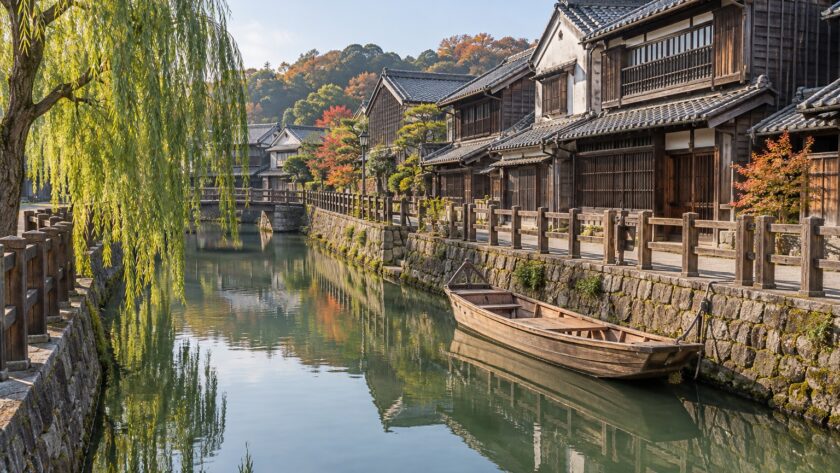
Information checked on October 10, 2026. Confirm local access, transport, weather and opening arrangements before departure, particularly after recent storms. The featured image is an AI-generated, photo-style illustration inspired by Sawara’s riverside townscape; it is not a photograph of an exact real location.
Understand the distances before choosing your base
Start with the regional picture on Visit Chiba, the prefecture’s official tourism website. Narita and Sawara are in the north, Choshi reaches toward the northeastern Pacific coast, and Tateyama sits much farther south. A hotel described simply as being “in Chiba” might therefore be poorly placed for your chosen sights. Compare actual station-to-station journeys and the final walk or bus connection before booking. Airport proximity and proximity to the beach are different advantages.
Rail works well for a trip built around towns, while driving offers more flexibility for scattered southern coastal stops and countryside accommodation. Allow for the time involved in collecting a car, finding parking and returning it. On a short break, using trains for the northern towns and renting locally for a separate southern stay can make more sense than driving throughout. Whichever option you choose, leave a genuine travel margin on the day of an international flight rather than counting only the advertised train journey.
Narita: a temple town worth staying for
Begin at JR Narita or Keisei-Narita station and follow Omotesando toward Naritasan Shinsho-ji. This is an approach to a major temple, with shops and restaurants forming part of the experience. Visit Chiba’s historic Narita guide maps the district and introduces its food stops. Walk down with time to browse, then choose where to pause on your return. If you are carrying a large suitcase, arrange storage before setting off; an enjoyable stroll becomes much less comfortable when you are dragging luggage through crowds.
Naritasan Shinsho-ji was founded in 940 and is associated with Fudo Myoo and goma fire rituals. The complex deserves more attention than a quick photograph at the gate. Look at the buildings, give worshippers room, and consider a walk into Naritasan Park behind the temple. If you hope to observe a ceremony, ask about the current schedule and visitor conduct. Treat it as a religious service, with quiet attention and respect for photography restrictions.
Narita is particularly appealing for a first or final night in Japan. A town-center stay makes it easier to enjoy the streets without continuously watching a departure clock, whereas an airport hotel may be more convenient for a very early flight. Compare the exact hotel location and shuttle arrangements rather than assuming every “Narita” property is walkable from the temple. For a layover, work backward from airline requirements, terminal transfers and entry formalities before deciding whether an excursion is realistic.
Sawara: waterways, merchant buildings and festival craft
Continue the historical theme in Sawara, now part of Katori City. Its waterways helped connect merchants with Edo, and the preserved district still combines old buildings with operating businesses. The prefecture’s Sawara introduction explains that commercial background. Begin beside the Ono River, watching how storehouses, wooden facades and later architectural additions fit together. This is a place for an unhurried walk, a café stop and a second look across the water, rather than a rapid sequence of separate admissions.
Flat-bottomed sightseeing boats offer another perspective when operating, but you do not need a boat ride to enjoy the district. Check the departure arrangements locally, especially if you have a train connection afterward. Keep bridges and shop entrances clear when taking photographs, and distinguish public paths from private thresholds. Sawara’s appeal comes partly from the fact that people still work here. Visiting a small business contributes more to that living townscape than treating every doorway as a photographic backdrop.
The Suigo Sawara Float Museum adds scale and context to the streets outside. Its displays introduce the elaborate floats, large figures and craftsmanship connected with the town’s festival tradition. Look for details that would be difficult to study during a moving procession: carved wood, textiles and the relationship between the figure above and the structure below. Check opening arrangements before visiting. If your main interest is the festival itself, use the current event schedule when choosing dates rather than relying on a general description of the summer or autumn season.
Sakura: give Japanese history an afternoon
Sakura offers a different historical experience at the National Museum of Japanese History. Exhibitions cover long periods of Japanese life and culture, including everyday activities as well as political and social change. Choose a theme that interests you—trade, belief, houses or food—and follow it through the galleries. This makes a large museum easier to absorb than trying to read everything. It also gives useful context to the temple towns, fishing communities and cultivated landscapes elsewhere in this guide.
Plan access carefully: JR Sakura and Keisei Sakura are different stations, and the museum’s official directions explain the appropriate walking and bus routes. At the time of checking, a September 2026 notice reported partial closures within galleries two, three and four. Check the latest notices before traveling for a particular display. Museum calendars and temporary works can also affect an otherwise straightforward day, so identify an alternative town walk or meal stop in advance.
Choshi: a small railway and a wide ocean
Choshi combines a working fishing town with a distinctive local train journey. The Choshi Electric Railway continues beyond the JR station toward coastal neighborhoods, including Inubo and Tokawa. Make the short railway part of the day rather than just transport between photographs. Choose two or three stops, look up the return departures, and leave enough time to walk from stations to the places you actually want to see. A small line does not necessarily offer the frequent service of central Tokyo.
Inubosaki Lighthouse is a natural focus for the coastal portion of the visit. The white tower, surrounding headland and open Pacific make a strong contrast with the narrow streets of northern Chiba’s merchant towns. Check whether climbing is available before making that the purpose of your trip; the staircase also matters for anyone with limited mobility. Tokawa can add a walk through a fishing neighborhood, but respect working areas and residential lanes. In windy weather, shorten exposed walks and settle into a sheltered lunch instead of insisting on every planned viewpoint.
Ichinomiya and Katsuura: choose your coastal rhythm
Ichinomiya brings together farmland and surf culture near the southern end of the Kujukuri coast. Visit Chiba’s Ichinomiya guide introduces Tsurigasaki Beach, where surfing made its Olympic debut in 2021, along with the surrounding town. Beginners should arrange a lesson with a local operator rather than assuming an internationally known surf break will suit them. Ask about conditions, equipment, transport from the station and cancellation arrangements when booking. Watching from shore, browsing surf shops and enjoying a café can be equally satisfying parts of the visit.
Farther south, Katsuura offers fishing-port culture, a morning market and coastal scenery. An overnight stay is useful if the market is your priority: you can start early without making your morning depend on a long journey from Tokyo. Vendor numbers vary, so approach it as a working local market rather than expecting an identical large event every day. Browse what is available, make a small purchase if something interests you, and leave room for lunch. Public beach access does not mean swimming is suitable year-round; follow seasonal lifeguard arrangements and local restrictions.
Mount Nokogiri: stonework, stairs and bay views
On the Tokyo Bay side of the peninsula, Mount Nokogiri combines former quarry landscapes with the Buddhist monuments of Nihon-ji Temple. The prefecture’s mountain guide explains the connection between Boshu stone and the mountain’s dramatic cut faces. The carved Kannon, large stone Buddha and viewpoints offer different reasons to explore. Do not treat the ropeway as transport to a single level viewing platform: the sites are spread over sloping ground, with walking between them.
Nihon-ji’s official website cautions that the grounds contain many stairs and uneven sections. As checked on October 10, 2026, it also reported a landslide-related closure on part of Route 127 between Hamakanaya and Motona, with access instructions for different approaches, and a separate closure on the approach footpath. Follow the latest local directions, not an old saved route. Consult the ropeway operator for current service and access information. Wind or maintenance can affect operations, and ropeway travel and temple admission are separate considerations.
Kanaya also connects with Kurihama in Kanagawa via the Tokyo Bay Ferry. The crossing can make an attractive part of a wider route, but the port is not central Tokyo, so include the journey to Kurihama when comparing options. Check both outward and return sailings, then identify a land-based alternative if weather interrupts service. For the mountain itself, start with comfortable shoes, water and enough daylight. Let visibility and access conditions determine whether this should be your outdoor day.
Tateyama and the rural landscapes of southern Boso
Tateyama suits a longer coastal stay rather than a distant add-on to a Narita afternoon. The prefecture’s Tateyama guide introduces bayside walks, Shiroyama Park and Nagisa-no-eki Tateyama, which combines visitor information with exhibits connected to the area’s maritime life. Use the first day to understand the town before heading toward more scattered coastal stops. A room near transport is practical without a car; a secluded seaside property is more appealing when you have confirmed how to reach it and where to eat.
In the hills near Kamogawa, Oyama Senmaida presents a carefully maintained terraced rice landscape. Its preservation activities are part of the attraction: these are working fields supported by people, not simply an empty scenic stage. Stay on permitted paths and never enter planted paddies for a better angle. The appearance changes with cultivation, harvest and the season, so expect an agricultural landscape rather than permanent bright green. Arrange onward transport before arriving; rural stops need more planning than a town with several railway services.
Tokyo Disney Resort: plan it as its own day
Tokyo Disney Resort belongs in a Chiba itinerary, but it deserves a separate decision and a separate day. Tokyo Disneyland and Tokyo DisneySea offer distinct experiences, and choosing a park is more useful than squeezing a brief visit around a distant coastal excursion. The official ticket page explains date-specific products, variable pricing and availability. Read the conditions for the ticket you actually buy; do not assume an ordinary one-day ticket allows unrestricted movement between both parks.
Use the resort’s purchase guidance and current calendar when organizing the day. Account for admission arrangements, meals, breaks and the journey back to your hotel. If the parks are the main purpose of your trip, accommodation convenient to them can be worth more than staying closer to another Chiba attraction. A resort-focused stay and a rural Boso stay solve different needs, and changing bases once may save repeated long transfers.
A family day in the hills
For families interested in animals and seasonal flowers, Mother Farm in Futtsu offers another way to spend a full day. The attraction combines farm-themed activities, animal demonstrations and planted landscapes, with the experience changing through the year. Check the day’s program before choosing your arrival time, and confirm bus connections if you are not driving. A published photograph of a flower field represents a particular season, not the appearance of every visit. Let children’s interests determine the order of activities, build in a meal break, and follow staff guidance around animals. This is an alternative to a strenuous mountain day, although the grounds still involve outdoor walking and slopes.
What to eat in Chiba
The prefecture’s regional food guide introduces peanuts, namero and Katsuura tantanmen. Peanut sweets make convenient souvenirs, while namero combines finely chopped fish with ingredients such as miso, ginger and spring onion. Katsuura tantanmen has a distinctive chili-oil character, with a soy-based soup, onions and minced pork. Ask about the heat level if you prefer mild food. These dishes make more sense enjoyed in the areas you are already visiting than pursued through a string of long food detours.
In Narita, consider an unagi meal along Omotesando, leaving time for a queue if you have chosen a popular restaurant. By the coast, look for what is available that day rather than expecting one fixed fish everywhere. Travelers avoiding raw seafood can ask about cooked dishes; those with allergies should check sauces, broths and preparation as well as the main ingredient. Buy perishable gifts close to departure and follow storage instructions. A leisurely local lunch often adds more to the trip than another distant attraction.
Two practical ways to spend three or four days
For a northern route, spend day one in Narita, combining the temple, park and a meal on Omotesando. Use day two for Sawara’s riverside district and float museum, returning to the same base if that keeps luggage simple. On day three, choose Choshi for coastal air and the local railway, or Sakura for a museum-centered day. With a fourth day, do the option you left out. This route suits travelers arriving through Narita who want several contrasting experiences without touring the entire peninsula.
For a southern route, begin with Kanaya and Mount Nokogiri if access and weather allow, then stay toward Tateyama. Spend the next day exploring the bayfront and a small number of nearby sights. A third day can move toward Kamogawa and a countryside stop, provided the transport connections work; a fourth can focus on Katsuura before returning toward Tokyo. This version is easier to customize with a car. Without one, reduce the number of bases and build the trip around the rail-accessible towns, using a prearranged local transfer only where it adds real value.
Make room for seasons and changing conditions
Spring flowers, summer seaside days, autumn walks and winter coastal light can all shape a Chiba trip. Choose the experience before the date: a swimming holiday, a festival visit and a quiet museum break have different requirements. Flowering and foliage vary with the year, while marine conditions can change much faster. Keep one indoor option and avoid placing every outdoor highlight on the same rigid day. After a storm, check access separately from opening hours—a venue may be open even when your preferred road or path is not.
Before departure, save your accommodation details, confirm the last connection you intend to use, and check the current notices for your main attraction. Ask directly about step-free access when needed, especially at older buildings, lighthouses and hillside temples. Chiba is most rewarding when you give its regions time: let Narita be a temple town, Sawara a place to wander, and the coast somewhere to stay long enough to notice the changing sea.