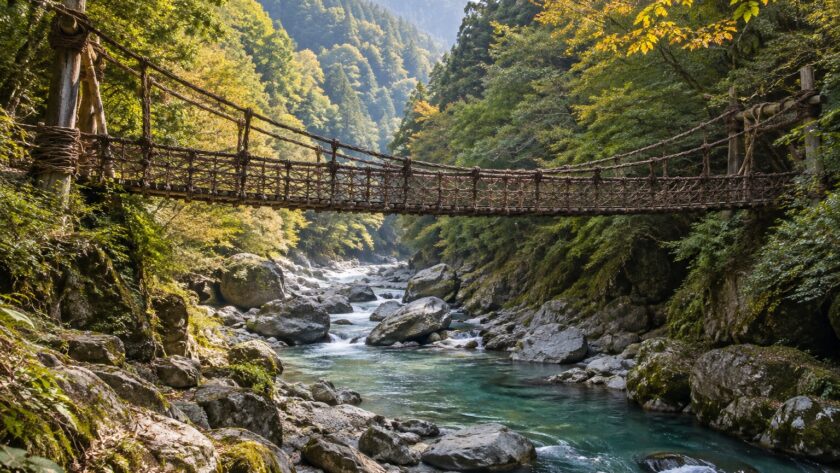
Tokushima introduces Shikoku through sound, color, and movement. Awa Odori dancers respond to an insistent musical rhythm; indigo cloth takes on deep blue tones; tidal currents twist into whirlpools beneath the Naruto bridge. Inland, the scenery changes to steep forested valleys, mountain villages, and vine bridges suspended above clear rivers. These experiences belong to the same prefecture, but they call for different kinds of travel.
A satisfying first visit combines an eastern base in Tokushima city or Naruto with a separate stay in the Oboke–Iya area. Pack for both city walking and cooler mountain evenings, with a light waterproof layer and shoes that grip well. Keeping luggage compact also makes rural buses and accommodation transfers easier. Four or five days give you room to enjoy the coast, cultural activities, and mountains without turning each day into a transfer. With only a weekend, choose one area and explore it properly. This guide explains how to connect the highlights while leaving space for tide times, performances, and mountain weather.
Getting to Tokushima and Organizing the Journey
The prefecture’s official access overview describes highway buses from the Kansai region, flights to Tokushima, ferries from Wakayama, and rail connections through Shikoku. Compare the whole journey from your starting point. A highway bus can be practical from Osaka or Kobe, while a rail route may fit travelers arriving through Okayama. Check current operator timetables rather than copying the example durations or frequencies in an older itinerary.
Tokushima Station is a useful base for the city and regional transport, but Naruto’s waterfront attractions are elsewhere. Check the exact stop for a sightseeing boat, museum, or hotel; a bus labeled for Naruto does not automatically deliver you to the right entrance. If arriving by ferry or plane, include the onward trip into town and leave room for a delayed arrival before reserving a performance or activity.
The west of the prefecture needs a different plan. Consult Miyoshi’s Oboke and Iya access guide before choosing accommodation. Oboke is a useful rail gateway, while local buses connect selected mountain destinations. The map may show several attractions close together, but roads follow steep terrain and winding valleys. A short straight-line distance can conceal a considerable journey, particularly beyond the main vine bridge.
A rental car makes some rural combinations easier, but it is not essential for a carefully limited visit. Travelers without a car should choose accommodation around a confirmed bus route or prearranged pickup. Ask exactly where and when a hotel shuttle operates. If you prefer not to drive narrow mountain roads, the tourism association’s taxi tour information offers another starting point for planning a tailored outing.
Awa Odori: Hear the Rhythm Before Learning the Steps
Awa Odori is central to Tokushima’s cultural identity, and you do not have to attend the summer street festival to encounter it. At the Awa Odori Kaikan, performances and museum displays introduce its music, costumes, and dancing. Watch how the dancers respond to the ensemble and how movement changes between groups. The enjoyment comes from the relationship between people and rhythm, not simply from a colorful photograph.
The hall’s English brochure explains daytime and evening performances and the audience participation element. Confirm the current calendar, ticket arrangements, and closure dates before going. If invited to join, follow the instructor and enjoy learning a few movements. If you prefer to watch, you can still appreciate the performance without feeling obliged to participate.
For the major summer celebrations, use the official event announcement for your travel year. Accommodation, transport, and seating arrangements can be very different from an ordinary city visit. Book your stay around the actual event you intend to attend, since celebrations take place in more than one municipality. Keep space in the evening for crowds and the return journey rather than assuming you can leave at the last possible moment.
A City Day Around Mount Bizan and the River
The Awa Odori Kaikan also provides the departure point for the Bizan ropeway. A ride up the mountain can help you understand the city and its surrounding landscape, especially when visibility is good. Check operating information separately from the hall’s performance schedule. Wind or maintenance can affect service, and the last descent matters more than the closing time of a nearby shop.
Keep the rest of the day simple: a walk along the central riverside, a meal, and perhaps an indigo appointment. This is a useful arrival-day combination because it avoids committing to a distant destination immediately after travel. Leave luggage at confirmed storage or your accommodation first. A light city afternoon can also provide flexibility if your scheduled activity takes longer than expected.
Choose your hotel according to your evenings as well as your morning departure. A station-area stay helps early transport, while another central location may suit dining and a performance. Check the walk back after dark and whether your preferred restaurant needs a reservation. There is little benefit in saving a few minutes at check-in if every subsequent journey begins with an awkward connection.
Naruto Whirlpools: Timing Is the Main Attraction
Naruto’s whirlpools form through the interaction of powerful tidal currents. They are a changing natural phenomenon, so arriving at a convenient hour is not enough. Consult the Uzu no Michi tide calendar for your actual date and build the day around a favorable viewing window. The published times indicate peak currents, and the strength of the tide helps determine what you may see.
The Uzu no Michi walkway runs beneath the Onaruto Bridge, with viewing areas high above the water and glass-floor sections. It offers a broad perspective on the strait and currents. Travelers uncomfortable with heights should consider that experience before buying a ticket. Check current opening hours and closure notices, and allow time to reach the entrance rather than arriving at the parking area at the predicted peak.
A sightseeing boat provides a closer, moving viewpoint. Naruto Kanko Kisen describes two vessels with different booking arrangements: its larger Wonder Naruto generally operates without reservations, while the smaller Aqua Eddy requires advance booking. Confirm the current rules for your chosen sailing. Choose according to your group’s preferences, boarding needs, and available tide window, rather than assuming every boat offers the same experience.
The operator’s access page identifies its boarding location and bus stop. Keep this separate from directions to the bridge walkway or another company’s pier. A departure time is a boarding deadline, so arrive with enough margin to buy or collect tickets. Weather can affect operations and visibility, and no photograph-sized whirlpool is guaranteed simply because you have booked the recommended time.
Otsuka Museum of Art: Understand What You Are Seeing
The Otsuka Museum of Art in Naruto presents full-scale ceramic reproductions of Western artworks. That distinction is essential: the attraction is the opportunity to compare major compositions and recreated settings in one place, rather than a collection of the original paintings. Approach it as a study of scale, imagery, and art history, and choose the works or periods that interest you most.
It can occupy a substantial part of a day. Do not treat it as a brief indoor stop between two tightly timed whirlpool bookings. The museum’s official visitor information provides its current calendar and entry arrangements. If you combine art and the strait, anchor the schedule to the tide first and give the museum a realistic block of time before or afterward.
This is also a useful option when weather makes outdoor plans less appealing, provided the museum is open. Comfortable shoes matter in a large exhibition space, and a pause can make the later galleries more enjoyable. Families or groups with different interests should agree on a meeting point rather than trying to remain together through every display. A selective visit often leaves a clearer impression.
Awa Indigo: Connect the Color with Its History
Tokushima’s blue is more than a branding color. The prefecture’s introduction to Awa indigo explains the importance of sukumo, the processed indigo material, and the trade that supported local prosperity. Learning a little about its production makes a dyed scarf or cloth more meaningful. It also gives context to the merchant architecture you can see farther inland.
The city’s indigo experience guidance recommends contacting facilities in advance and notes that English-speaking staff may not be available. Confirm the activity, length, materials, and language support directly. Ask what you will make and whether it can be taken away immediately. Wear clothing you do not mind getting marked and follow the workshop’s advice about sleeves, gloves, and handling dye.
Give the process your attention rather than concentrating only on the finished pattern. Folding or tying the fabric, repeated dipping, and the developing color can make a short workshop memorable. When shopping afterward, ask about washing and care. A small, well-chosen piece is easy to use at home and offers a tangible connection between the prefecture’s agricultural history, craft skills, and present-day makers.
Wakimachi: Merchant Houses Along the Yoshino Valley
Wakimachi’s Udatsu townscape grew from the prosperity of merchants and the indigo trade. Look upward to find the projecting firebreak walls that give the streets their name. Their elaborate treatment expressed wealth as well as serving a practical purpose. The houses, rooflines, and street proportions make this a place for careful observation rather than a quick stop at one monument.
Allow time for a slow walk and whichever historic interiors or shops are open. The regional visitor guide places the district a taxi ride from Anabuki Station, so include that final connection in a rail-based plan. Confirm the return arrangement before wandering away. Do not assume a rural station and a preserved townscape are adjacent simply because they appear under the same destination name.
Wakimachi can form a separate excursion from Tokushima city or a considered stop while traveling west. If you have luggage, establish storage or keep it securely with your transport. Respect occupied homes and avoid blocking narrow entrances for photographs. The most useful souvenir here may be a better understanding of how the Yoshino River and indigo commerce shaped the region’s towns.
Oboke Gorge and the Journey into Iya
Oboke is a natural gateway to the mountains, with the Yoshino River flowing through striking rock formations. The Oboke Gorge sightseeing boat operator offers a way to experience the gorge from the water. Its current guidance warns that high water, strong winds, or storms can cancel trips, while low water may shorten the route. Check conditions before organizing your entire day around a sailing.
Use the tourism association’s maps, luggage information, and bus timetables to plan the onward journey. A station arrival does not mean you are already at the boat landing or your mountain accommodation. Save the relevant timetable and agree on a pickup location if someone is meeting you. Mobile information is helpful, but a downloaded map is easier to consult when reception is inconsistent.
An overnight stay changes the experience of Iya. You can enjoy dinner and a bath without rushing back toward the city, then begin the next day closer to your chosen sights. Ask whether meals are included and whether there are realistic alternatives nearby. Rural accommodation may have firm dinner and check-in times, and a late arrival can affect much more than the convenience of reception staff.
Iya’s Vine Bridges: Choose the Right Destination
The main Iya-no-Kazurabashi spans the river with a deck whose gaps and movement make crossing an unusual experience. Its origins are surrounded by stories, including traditions associated with the defeated Heike clan; present them as legends rather than settled historical proof. The bridge continues through regular rebuilding, reflecting an inherited practice rather than an untouched medieval structure.
Wear secure shoes, keep hands available, and think carefully about heights, balance, and your companions’ comfort. You can appreciate the setting without making everyone cross. Read the staff instructions and allow people ahead enough space. The official listing distinguishes daytime crossing from nighttime illumination, when crossing is not permitted. An illuminated bridge should therefore never be treated as an invitation to enter after hours.
The Oku-Iya Double Vine Bridges are a separate destination deeper in the mountains. Their listing gives a winter closure from December through March, so check the current season’s notices before traveling. Do not confuse them with the main bridge when entering a destination into navigation. Reaching the deeper valley requires additional time and a transport plan that still works for the return journey.
If extending farther into Iya, Ochiai Village offers a view of homes, fields, and stone walls arranged across steep slopes. It remains a living community. Use appropriate viewpoints, keep private land private, and avoid treating every house as a tourist facility. Choose one or two additional stops rather than attempting every mountain attraction before driving back in darkness.
A First Encounter with the Shikoku Pilgrimage
Ryozenji, Temple 1 of the Shikoku 88-temple pilgrimage, provides a meaningful introduction to another aspect of Tokushima. You can visit respectfully without committing to the complete circuit. Notice the flow of worship and leave space for those praying. Temple stamps, ritual objects, and white pilgrimage clothing have a religious context and deserve more thought than ordinary souvenirs.
For a short visit, keep the plan modest and learn the etiquette as you go. Follow photography notices and ask before taking close portraits of pilgrims. Anyone considering a longer walk should research the specific route, accommodation, terrain, and weather separately. A gentle first temple visit does not indicate that every section of the pilgrimage is similarly easy or close to public transport.
What to Eat and How to Spend Five Days
The prefecture’s food guide highlights sudachi citrus, Naruto wakame, and Naruto Kintoki sweet potatoes. Look for them across meals rather than expecting one restaurant to represent the whole region. A squeeze of sudachi can bring a sharp aromatic note to a dish, while sweet-potato snacks make a simple break between visits. Ask what is seasonal and locally available.
Tokushima ramen includes several broth styles, with the familiar brown version associated with a rich pork-and-soy profile. Pork belly, rice, and an egg can feature in the meal, but toppings vary. Check ingredients and preparation if you have dietary restrictions. In Iya, look for local soba and other mountain dishes, and remember that buckwheat noodles and their broth need separate ingredient checks.
Day one: arrive in Tokushima city, walk near the river, and attend an Awa Odori performance. Day two: visit Naruto around the tide, adding the art museum if time allows. Day three: choose an indigo workshop or Wakimachi, then travel west with enough time for dinner at your accommodation. Avoid filling the transfer day with both activities unless the connections genuinely fit.
Day four: enjoy Oboke and the main Iya vine bridge at a comfortable pace. Day five: add a deeper-valley excursion with arranged transport, or return toward the east for Ryozenji and onward travel. Winter, rain, or limited buses may favor a shorter mountain stay. The best Tokushima route gives each experience its own conditions: strong currents for Naruto, attention for craft, and daylight for the valleys.
Editorial note: Official sources were checked on October 10, 2026. Tide predictions, boat operations, performances, mountain transport and seasonal closures can change; confirm with the linked operators before travel. The featured image is an AI-generated illustration inspired by Iya Valley’s vine bridges, not a documentary photograph or exact structural record.