A visit to Kiyomizu-dera begins before you reach its famous wooden stage. The approach climbs through shops and houses, the city drops away behind you, and the roofs of the temple gradually replace the shop signs. That change of pace is part of the experience. Allowing time for it makes a difference: this corner of Kyoto is best enjoyed as a connected neighborhood, with the temple as its focus.
This guide combines a thoughtful temple visit with the lanes of southern Higashiyama, a proper meal and a realistic route toward Gion. Choose the three-hour version for the essentials or allow five to six hours for another temple and lunch. Both require walking on slopes, and neither depends on finding empty streets. For planning the rest of your stay, see our Kyoto travel guide.
Get the geography right before you go
Kiyomizu-dera stands uphill on Kyoto’s eastern side. Below it, Kiyomizu-zaka connects with the stepped lanes usually called Sannenzaka and Ninenzaka. You may also see the spellings Sanneizaka and Nineizaka. Farther north are Nene-no-michi, Kodai-ji Temple and Yasaka Shrine; Gion and the river lie downhill to the west. These places form a walkable cluster, but a short line on a map does not show the climb, steps or crowds.
Start with the temple if an early visit matters most, then work downhill through the neighborhood. Start farther north if shops and a leisurely approach matter more, accepting that you will reach Kiyomizu later. Avoid repeatedly climbing back to retrieve a missed café or photograph. Save your chosen meal location and your eventual departure station before leaving your accommodation.
One useful distinction prevents confusion: Yasaka Pagoda belongs to Hokan-ji Temple, while Yasaka Shrine is a separate destination farther north. The pagoda is the tall landmark seen between traditional streets; the shrine has its own precincts and worship traditions. Mark both separately if you intend to visit them. A route labeled only “Yasaka” is not precise enough when you are trying to meet friends or estimate the remaining walk.
What makes Kiyomizu-dera more than a viewpoint
Kiyomizu-dera’s central devotion is to Kannon, associated with compassion. The temple’s introduction to its religious purpose is a useful starting point: visitors come here to pray as well as to admire the setting. Even without a background in Buddhism, you can appreciate the different kinds of attention the place invites. Look outward at Kyoto, then turn toward the hall and notice the people who have come for reasons other than sightseeing.
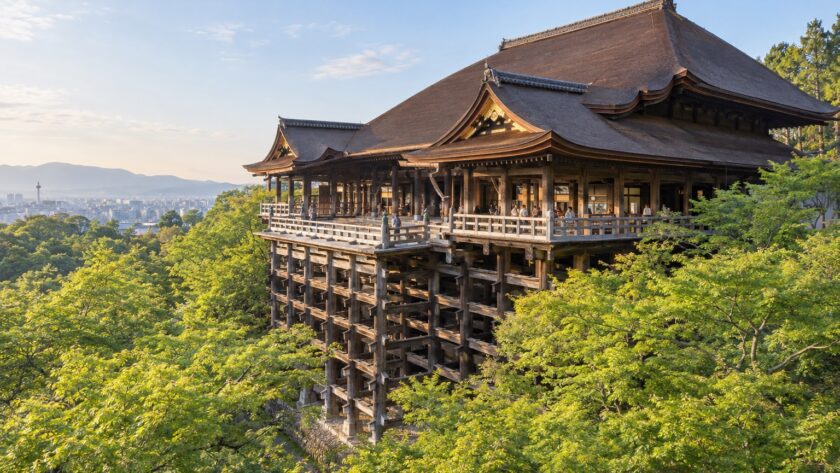
According to the temple’s history and architecture guide, its foundation dates to 778, while many surviving buildings were reconstructed in 1633. The stage projects from the Main Hall over the hillside, supported by a framework of timber pillars and connecting rails. Its floor uses Japanese cypress, and the broad roof is covered with cypress bark. The stage also has a religious purpose: performances are offered to Kannon on special occasions.
Rather than memorizing dimensions, look for the relationship between floor, roof and slope. From the stage, the structure can feel like an ordinary terrace. Seen across the valley, its support system becomes much clearer. That contrast is worth seeking out. Give yourself a moment without the camera to notice the scale of the eaves, the changing light on the wood and the distance between the temple and the streets below.
A sensible route through the temple grounds
Use the official grounds map to identify Nio-mon, the Main Hall, Okuno-in and Otowa Waterfall. Begin at the entrance gates, continue to the ticketed Main Hall area, and follow the signed visitor route onward. Okuno-in provides the celebrated view back toward the Main Hall and its stage. Otowa Waterfall connects the visit to the water from which the temple takes its name.
Allow around sixty to ninety minutes for a first temple visit, longer if you want to linger, receive a temple seal or join a queue. This is an editorial planning allowance, not an official minimum. Separate the things you want to understand from the things you want to photograph. If your group includes someone less interested in architecture, agree on a meeting point before splitting up rather than expecting everyone to move at the same pace.
At Otowa Waterfall, watch the current arrangements and follow staff guidance. The temple describes the water in terms of purification and prayer; you do not need to turn the visit into a competition to collect different promised benefits. A long queue need not dictate the rest of your morning. Observing respectfully and continuing along the route is a valid way to experience the place.
Check closures before adding side attractions from older guidebooks. Jishu Shrine’s official website currently says it is closed for renovation, with no reopening date specified. Do not plan on entering it or trying its famous love-divining stones. Likewise, special interior visits and gardens are separate opportunities with their own schedules; an ordinary temple visit does not guarantee access to every named building.
For a small set of photographs that tells the story, think in three scales: the whole hall across the valley, the timber details visible from a permitted path, and the city beyond the railing. Each explains something different. A person included at a respectful distance can convey the building’s size, but avoid making an identifiable worshipper the subject without permission. Review your images away from narrow passages, and accept that some views will include other visitors.
Opening times, tickets and the early-morning trade-off
The temple opens at 6 a.m. Its official 2026 timetable lists closing at 6 p.m. for much of the year, with later summer hours and selected special evening openings. For autumn 2026, November 21–30 is listed for extended opening until 9:30 p.m., with reception ending at 9 p.m. Those are dated arrangements, not a recurring promise for future years. Check the timetable for your actual visit.
For a price reference, the temple’s 2026 special-viewing announcement lists ¥500 for adults and ¥200 for elementary and junior-high students. Confirm the applicable admission and any separately charged special viewing before arrival. Carry some yen rather than relying on an unverified payment method. A small admission cost can still cause inconvenience when the rest of the group is ready to enter.
Early arrival gives you more of the day to work with, but it does not guarantee solitude. It also creates a practical gap: the temple can be open while your preferred breakfast place or souvenir shop remains closed. Eat something before leaving or identify an early-opening option in advance. If browsing is a major reason for coming, a slightly later start may suit you better than finishing the whole neighborhood before its shops open.
Reach the hillside without relying entirely on buses
From Kyoto Station, one useful option is JR to Tofukuji, then Keihan to Kiyomizu-Gojo, followed by the uphill walk. Kyoto’s official access guide puts the station-to-temple walk at about twenty-five minutes and recommends rail-based approaches because road traffic can delay buses. Treat that walking estimate as movement time: finding the exit, stopping and climbing slowly add time.
Another approach uses the subway to Higashiyama Station, changing from the Karasuma Line to the Tozai Line at Karasuma Oike. This suits a longer walk through the district rather than the quickest direct climb. Kyoto’s suggested route from Higashiyama Station estimates roughly forty to forty-five minutes of walking past several landmarks. Entering those places turns it into a much longer outing.
Buses can still be useful, particularly when your accommodation is near a convenient stop. Compare the day’s service with your actual starting point, and remember that getting off at Gojozaka does not remove the final climb. A taxi can reduce the approach but is not a guarantee of delivery to the Main Hall. For mobility needs, discuss the appropriate access point before setting off rather than relying on the closest-looking road.
The temple’s location page warns that mapping apps sometimes suggest routes that do not enter the grounds. Its entrances are reached via Kiyomizu-zaka at Nio-mon or via the emergency-road entrance above Chawan-zaka. Use the official approach map when directions look improbable. Do not follow a shortcut through a closed gate simply because a phone displays a blue line.
Sannenzaka and Ninenzaka: enjoy the walk downhill
After the temple, descend Kiyomizu-zaka and turn into the stepped streets leading toward Sannenzaka and Ninenzaka. Kyoto’s official neighborhood walking guide describes their stone steps, paved lanes and shop-lined setting. Slow down here for details rather than only searching for a famous camera angle: shop curtains, ceramic displays and the changing roofline give the walk its texture.
The slope is part of the attraction and part of the effort. Walk at a pace that lets you look up without losing track of your footing. At busy moments, stop beside the flow of people before reading a map. Photographs taken from the middle of a stairway tend to interrupt everyone behind you. If you are visiting with children, choose a visible meeting point before entering a shop instead of assuming the group will naturally stay together.
Not every appealing doorway is an invitation to enter. The area contains homes and working businesses as well as visitor attractions. Follow signs, keep voices low near residences and ask before photographing inside shops. An attractive street does not become a pedestrian-only film set. Take your picture, make room for others, and leave enough flexibility to enjoy a shop that catches your attention without turning the route into a shopping checklist.
Yasaka Pagoda, Nene-no-michi and one extra temple
Make a short detour toward Hokan-ji’s Yasaka Pagoda for the contrast between its stacked roofs and the surrounding streets. Plan around viewing the exterior; confirm local notices if an interior visit matters to you. Keep clear of vehicles and entrances when composing photographs. The useful question is not whether you can reproduce a particular social-media image, but whether the scene works from a place where you can stand considerately.
Continue toward Nene-no-michi and choose whether to enter Kodai-ji. Its official history connects the temple with Nene, who established it in 1606 in memory of her husband, Toyotomi Hideyoshi. Gardens, memorial architecture and lacquer decoration offer a different focus from Kiyomizu’s hillside stage. Choose this stop if you want to spend time looking closely, rather than because another famous name is nearby.
Kodai-ji’s current visitor information lists adult admission at ¥800, last entry at 5 p.m. and closure at 5:30 p.m. Special evening arrangements can differ. Budget approximately forty-five to sixty minutes as a personal planning allowance. If your energy is fading, continue toward Yasaka Shrine instead of buying another ticket simply to rush through a garden.
At Yasaka Shrine, remember that shrine worship differs from Buddhist temple practice. The shrine’s own worship guide describes two bows, two claps and a final bow around the prayer. Do not automatically copy that sequence at Kiyomizu-dera. Visitors who prefer to observe can do so quietly. Finish here or continue west toward Gion-Shijo and Kyoto-Kawaramachi for onward transport.
Plan lunch before the snack shops take over
Choose whether lunch is a central experience or simply a break. For a slower meal, yudofu and yuba provide an introduction to tofu-based cooking: the former centers on warmed tofu, while the latter uses the delicate skin formed from heated soy milk. Texture and accompanying dishes matter as much as strong seasoning. Leave enough time to sit down rather than expecting a multi-dish meal to fit between two timed visits.
Kiyomizu Junsei Okabeya, near the temple approach, is one concrete option. Its English page describes in-house tofu making and barrier-free seating, and lists yudofu and yuba courses. It also lists daytime service, so it should not be assumed to be a dinner fallback. Check the current menu and notices before choosing it, and confirm access details that matter to your group.
A tofu-focused restaurant is not automatically vegetarian or vegan in every dish. Broths, sauces and accompaniments need checking, and dietary requirements should be explained specifically. Travelers with allergies should discuss ingredients and preparation directly with the restaurant. If a particular meal is essential, make it the fixed point of the itinerary and arrange the rest around its opening time.
For a lighter day, choose one savory lunch and save a tea or sweet stop for later. Buying several snacks during the descent can leave you tired and still without a proper rest. Use the shop’s designated eating space when available, and keep packaging with you until you can dispose of it appropriately. Eating and navigating steep, crowded steps at the same time adds little pleasure.
Tea, sweets and souvenirs with a connection to Kyoto
A matcha stop works best when you decide what experience you want: a bowl of tea, a substantial parfait or a quick cold drink. These are different uses of your time and appetite. If you continue into Gion, Saryo Tsujiri’s Gion main store is one operator to check for a tea-and-dessert break. Treat it as an optional extension, allowing for its current service hours and any wait.
For an edible gift, compare baked yatsuhashi with the soft varieties before buying. Check the package for ingredients, storage instructions and the date by which it should be eaten, especially if Kyoto comes early in your trip. Izutsu Yatsuhashi’s official site lists a Kiyomizu shop at Seiryu-en, providing a specific place to research rather than assuming all souvenir stores carry the same range.
Pottery rewards a little curiosity. The Kiyomizu-yaki pottery association explains the diversity of Kyoto ceramics, including different materials, glazes and decorative approaches. Ask who made a piece, where it was produced and how it should be cared for. A small cup or chopstick rest may be easier to carry than a large bowl. Request protective packing and keep fragile purchases in mind before adding more stops.
For a compact alternative, Shoyeido’s Sanneizaka store offers incense in the immediate neighborhood. Choose a scent you actually enjoy instead of buying solely for the packaging. Food, pottery and incense all make useful souvenirs when the purchase follows your interests. You do not need to collect one of each to make the walk feel complete.
A focused three-hour route
Count these three hours from arrival at the temple entrance, not departure from your hotel. Spend the first sixty to ninety minutes at Kiyomizu-dera, including the Main Hall, the view from Okuno-in and the signed route toward the waterfall. Keep optional queues optional. If a meaningful temple visit takes longer than expected, shorten shopping rather than hurrying through the main reason you came.
Use the next forty-five to sixty minutes for the descent through Sannenzaka and Ninenzaka, with a short pagoda detour if it fits comfortably. The remaining time allows a brief refreshment stop and a continuation toward Nene-no-michi or an exit from the neighborhood. A seated course lunch and a full Kodai-ji visit are not included. Allow additional time to reach your train or bus afterward.
If you start near opening time, bring breakfast plans that do not depend on late-opening shops. If you start later, decide in advance how much waiting time you will accept for food. This version suits travelers combining Higashiyama with another part of Kyoto, but keep the next commitment flexible enough to absorb a slow descent or a crowded station.
Keep the return journey separate from sightseeing time. Before the final stop, check which station best matches your destination and whether you need to retrieve stored luggage. If you have an onward train from Kyoto Station, leave a generous margin for the transfer rather than treating your departure from Gion as arrival at the station. Ending the walk with time to spare is particularly valuable on a day when every photo stop has taken longer than expected.
A five-to-six-hour visit with lunch and another stop
For the longer version, begin with roughly ninety minutes at Kiyomizu-dera, then allow an hour for lunch near the approach if the restaurant is open. Continue through the historic lanes with forty-five to sixty minutes for walking, shops and the pagoda exterior. The precise order of lunch and browsing depends on your start time; avoid descending far downhill before returning for a reservation near the temple.
Devote another forty-five to sixty minutes to Kodai-ji if its gardens and history interest you. Continue toward Yasaka Shrine, then finish with tea or a walk toward the railway stations. The remaining margin covers pauses, toilet stops and queues. These are suggested time blocks, not a timed tour or a promise that every traveler will finish within six hours.
Choose one optional stop to drop before you start. For families it might be the second temple; for keen photographers, a long dessert queue; for food-focused travelers, extra shopping. This makes adjustments easier when the day is hot or busy. A coherent morning in southern Higashiyama is more useful than trying to append distant sights simply because the itinerary still has a blank space.
Accessibility, weather, photography and a realistic budget
Kiyomizu-dera’s official FAQ describes barrier-free routes for wheelchairs and strollers, accessible toilets and a map available at Todoroki-mon. It states that wheelchairs are not available to borrow. Arrange your approach separately from the temple circuit: the famous stepped shopping lanes are not interchangeable with the accessible route. Contact the temple beforehand if vehicle access is needed, and confirm your restaurant entrance too.
Wear shoes you trust on slopes and wet paving. In rain, shorten the shopping circuit and prioritize a seated break; umbrellas take space on narrow steps. In hot weather, reduce the number of stops and carry water. Leave large luggage at your accommodation or use an appropriate storage service before entering the area. Do not assume lockers will be available exactly where you need them.
The temple prohibits drones, tripods and monopods, and restricts commercial recording without permission. Follow signs for individual spaces and avoid blocking worshippers. Around Gion, respect private lanes and do not chase or photograph working maiko without permission; Kyoto’s official area guide emphasizes considerate behavior. For ordinary travel photographs, a handheld camera and patience are more useful than elaborate equipment.
As an editorial allowance, budget roughly ¥4,000–¥6,000 per adult for a casual half-day with temple admission, lunch and a tea break, excluding transport and shopping. A course meal or extra paid attraction may require more. Keep a small reserve rather than treating every published price as permanent. Choose the experiences you most want, check their current details, and let the spaces between them remain part of the visit.
Editorial note: Official sources were checked on October 11, 2026. Opening hours, fees, closures and restaurant arrangements may change; consult the linked operators for your travel date. Itinerary timings and the overall budget are editorial estimates. The featured image is a photo-style AI-generated illustration inspired by Kiyomizu-dera’s wooden stage, not a documentary photograph or an exact architectural record.